Showing posts with label Chris. Show all posts

Friday, August 1, 2014

Why should you care what I did in Korea?

Since returning to the United States, I have talked to many people about the trip. Some of the most popular questions include:
  • "What was the weirdest food you ate?"
  • "What was your favorite part?"
  • "What was the worst part?"
  • "Where did you go?"
  • "Who did you go with?"
Many more questions follow, but one that makes me the most excited is "What are you going to do with what you learned?" You may think this is weird, but as an educator, I am always striving for more knowledge. If I can share that knowledge, then I am sharing one of my greatest passions.

Chris Wilder, Kelli Hamilton and Jason Steward
This week I was able to work with Chris Wilder and Jason Steward again to share our experience with fellow Ag Educators at the Florida Association of Agriculture Educators conference. There were about 15 people in the session. We experienced a great open discussion with the teachers that posed many valid questions.

With the assistance of Jeremy Rhoden, we were able to tie in the experience (global education) to Florida Sunshine State Standards of the various agriculture courses offered in Florida schools. This showed them where it was required that they teach about agriculture on a global scale. But we also shared ideas on how to include global agriculture and global economies in all the courses and levels that we teach.

As an introduction for the session I prepared this video. It was a short something for them to see a little bit of what we did and why we went to Korea. It also started their wheels rolling.


We had a lot of positive feedback from the participants. I am proud to say that at the end of the information session, there was an enthusiasm for the upcoming year and including more global aspects to our curriculum.


Dr. Kirby Barrick, Jason Steward, Chris Wilder, and Kelli Hamilton


If we are to help develop globally competent individuals, we need to be able to relate the things we interact with everyday to the world around us. It is not just about our small community, it never was. We are just a small piece in a giant puzzle. As educators, it is our responsibility to start and continue opening the eyes of our students, to help them realize that, no matter what, we are all connected; if by nothing else than agriculture.

Saturday, July 12, 2014

Meaningful Interactions


Although we have recently returned to the U.S., we will continue to post thoughts and stories from #AgEd2Korea participants to reflect on the breadth, depth and diversity of our experiences in Korea.  This blog showcases some of the answers to the question, "What was your most meaningful interaction with a Korean person?"

Deanna and her SNU Teaching Partner
"My most meaningful interaction was with my SNU teaching partner. Not only did he help us with translations and logistics, but he helped us to structure our lesson and make it more impactful for the students in the classroom. He could have sat back and watched as we prepared a lesson but he was engaged and inqusitive the entire time. It makes me wonder how I would have responded in his situation." – Deanna

"My most impactful interaction was when we got to meet the Vice Minister of Education, Dr. Na. I am always excited to meet another OSU Alumni, and one who has made such an impact on the education system, just makes it that much more exciting. He had some very insightful words about finding your passion and dedicating yourself to it. If you are not building your passions, you will not have a very rewarding life." - Kelli

Lesson Planning: Kelli, Hee Song and Janae

"I loved working with my SNU teaching partner, Hee Song. She was absolutely awesome! She really had a presence in the classroom and I really enjoyed being able to team-teach with her. What really surprised me though was the note she left me on our last day together. She wrote that my passion for teaching helped to ensure that she was in the right profession as well. It was an incredible complement and she has impacted me in just the same way."
– Janae


"When I went to Insadong for the second time, as I was shopping I had a group of 13 year-olds and their teacher run up to me and speed quiz me on camera as an English project in order to help them learn to better speak English. They were a great group and they were so excited to talk to me and enjoyed talking to me in English & Korean and it was great to see students that excited to learn new languages." - Amanda

"At Buseong Elementary in Gwangju, I asked a 6th grade student how she was doing and she responded in English by saying, “I am happy!” This was evidence of the successful implementation of the school’s mission statement, which included 'Happy Students'.” - David

Jeremy's class at Yeoju High School
"My most meaningful interaction with a Korean has been with the students at Yeoju High School. They were so excited to have us in their classroom and learn about agricultural education in America. They were the friendliest, most respectful students I had ever met and they made me want to come to Korea and teach here for a while!" - Jeremy

"My most meaningful interaction with a Korean was when Jason and I were coming home from a late night out on the town and we met Jim, a Korean student from SNU. Jim was very kind, patient and engaging. We met Jim on the subway, we all three walked home even stopping long enough to grab a bite to eat and drink, just like we had known him for years. He even answered his phone to his girlfriend saying he had met some new friends and would be home late." - Chris

Jessica, Cassidy and Abby having lunch with a Suwon Teacher

"My most meaningful personal interaction with a Korean was probably the day that we went to lunch with the Suwon teachers for bugolgi. It was meaningful because although there was a language barrier, we had a normal conversation, just like I would have with my friends. We talked about our school day, what we love about our jobs, and about our family. It was neat to share those things, and I didn’t feel pressure to make sure I was speaking perfectly. They were just happy to interact with us, like we were with them. I wish I would have exchanged contact information with them, a lesson learned, but I really enjoyed lunch that day, and wish we could have had more one on one time with just the teachers. " - Abby
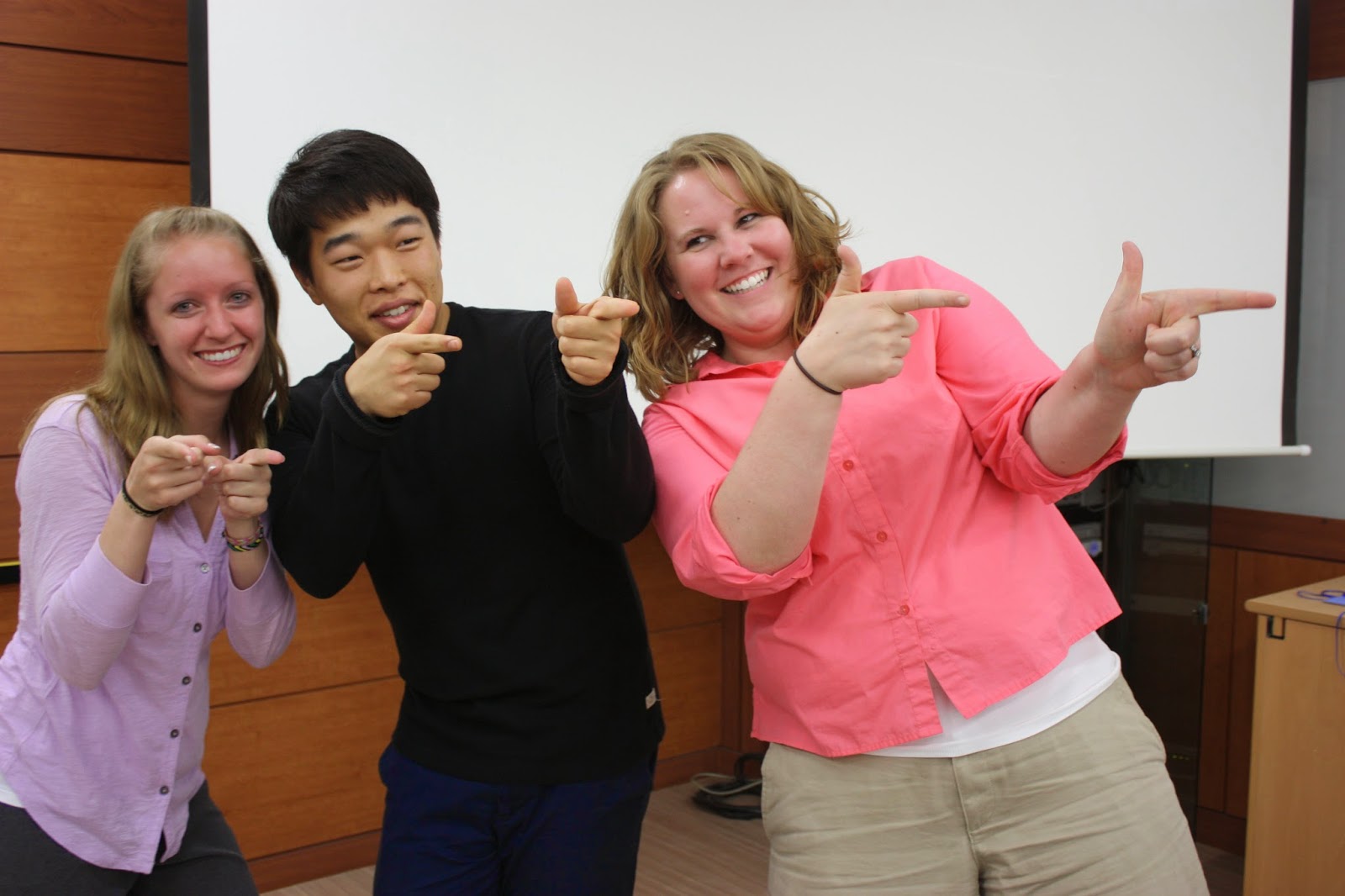
Teaching Team: Stacia, NeungSu and Jessica
"My most meaningful interaction with a Korean is my work with my SNU teaching partner NeungSu. Through teaching together I really had to rely on him to translate to our class. We also had to work on our own communication together for him to be able to help translate. It has definitely helped me realize how to speak more clearly and how to work with a partner in the classroom. Out of the classroom he has also given me a lot of insight into Korean culture. I have had the opportunity to ask him all about his traditions which was
a lot of fun to learn about." - Stacia


Wednesday, July 9, 2014

Happy Education for All: Creative Talent Shapes the Future!

The title of my post is the vision statement for the Ministry of Education for the Republic of Korea.  Today we had the opportunity to meet the vice minister of education Dr. Na.

Dr. Na is a former agriculture teacher, who earned his PhD from The Ohio State University.  It is a small world, where anything is possible.  The fact that he is a former agriculture teacher resonates in my head this afternoon.  Dr. Na is leading the way to have a paradigm shift in Korea, that it is alright for educated people not to have an inflated resume of degrees to become professional citizens of the community.

The idea begins with happy schools, what a novel idea.  Happy schools focus on expanding the student's background of education.  It would include more exposure to the humanities, sports and character building.  Integrating liberal arts with the sciences.  This approach would surely unleash the potential in any student.


Next the plan calls for quality colleges to foster creative talent.  This is accomplished through ideas that we have seen first hand on this trip, opportunities for students to study abroad and truly become a global student.  The use of capstone projects through team activities conducted at the school, and even to compete with the project where there was evidence of industry partnerships.  This will lead to more localized employment for those students and thus a better economy.  Similar to programs FFA had where students worked and studied abroad, perhaps it is time to revisit old ideas that worked.


Finally the piece that interested our group the most was the initiatives in a meritocratic society.  The number of degrees one earns does not mean that the individual is any better or worse than the next individual.  That to create a more even playing field is a positive move in a country that values it's educational programs.  Agriculture education and vocational education in general is taught in the general curriculum, as well as in specialized schools, that promote scholarships to help to encourage students to consider those schools.  

It doesn't matter what country you live in, you want what is best for your children.  I believe I live in such a country and that the United States of America is a place where as the Minister of Education says your dreams of education do come true.  If you can dream it you can achieve it, see you at the top. Thanks Zig, that's why it has been so important on this trip to stay positive.


Tuesday, July 1, 2014

More Tea, Please

Tea Plantation
This wonderful drink we refer to as tea is so much more, it is not just the cultivation of a plant but is the cultivation of a culture.

Today we traveled to Boseong province to learn more about the production of tea in Korea.  In this beautiful mountainous province we visited Da Hyang High School.  This school is a small rural high school which contains two programs the auto mechanics with approximately 115 students and the tea school which is comprised of 75 students.  

This school was originally an agriculture high school until enrollment fell to low.  When they decided to specialize in auto mechanics and tea production and processing enrollment went back up.  The students in the tea school are responsible for the production and processing of the tea. They had an expansive mechanized tea processing facility however they demonstrated the technique of hand made tea, very tedious. 

Their finished product is sold to the local community, sounds a lot like back home.  When we have student based agricultural experiences that create a product it is sold to financially support the program.  This school just took it to another level.  They were providing for their community by developing future employees for the local tea industry.

The local tea industry includes the largest tea plantation in Korea.  This plantation contained 1650 hectares of cultivated tea.  The plantation employees 1200 people and is the largest of the 200 tea plantations in the area. The tea produced is classified organic by Europe, Japan and the USA.  The highest quality tea is picked in the spring by hand and is classified green tea.  This plantation's mark of excellence is known throughout the country for its, safety, taste and overall quality thus it receives a higher price than other plantation's tea.  Tea, just like our quality agriculture education programs we make our mark with our students and they in turn become beacons of excellence, something everyone  can recognize.  

The finished product is great tea.  The tea plant is a member of the Camilla family and all tea is green tea, the other types such as red and black are just processed in a different manner.  The Korean  tea ceremony honors all of the hard work conducted to get the final product to the pot.  The tea is to be savored and enjoyed so the five flavor scan be enjoyed, bitterness, sweetness, sourness, astringency and saltiness.  Just as many times educators find ourselves enjoying the hard work and devotion of our profession throughout the various senses.  We know that students need to learn through various techniques to become their own.  And finally the tea is to evoke a special time of reflection.  Time when as an agriculture teacher I know that my students were impacted by the lesson, that their person was cultivated and that they as a student were made better, just like the tea.


Monday, June 23, 2014

Rain Rain Go Away


 Wet conditions of the streets of Seoul
As I prepared for this amazing journey and grand adventure I set Seoul South Korea as one of the cities on my Weather channel app. It alerted me that "Seoul is cooler and rains a lot less than Williston".

Well, today the weather was just like that from Florida, rainy!  I felt right at home.  This rain did not dampen the spirits of this small band of agriculture teachers, we carried on.

This was our first "free" day so we decided to spend it exploring further some of the beautiful museums and shops that we had been exposed to over the last two days. Well, we found that many of these museums are closed on Monday but we still found an amazing city which to dive into.

Seoul Station - metro, train and bus.
Mass transit at its best!  Seoul knows how to do it. The Seoul train station is just one example of this country's ability to move people. Something I look forward to riding in the next few weeks. The other is its intricate system of the metro and bus lines.  All moving people to and fro with the greatest of ease and all on the same public transportation payment card.

While on these transit options every Korean is connected to an electronic device.  Cell phones are in everyone's hand, plugged into the world.  It crosses all ages and genders.  Everyone is "wired" up and connected.

There is a bar code on the back of each card and is read at every stop and the correct "won" is deducted to ride from station to station.  Very efficient! All Koreans seem to be able to navigate these transportation options, swipe their payment card, which they keep in a very handsome wallet.  Everyone stays connected through transportation. 

I make this simple observation to say that we all need to stay connected.  In our everyday lives many times we don't stay connected, and I am guilty of this.  Our profession as agriculture teachers only gets strong when we stay connected.  I know this, understand this however I need to practice it a little more.  Being connected to these wonderful professional on this trip will only strengthen my will to grow and become a better teacher.  This international agriculture education experience has opened my eyes to the ability of us to stay connected where borders do not matter.  Just like the t-shirt reads: Teach Ag Beyond Borders!  
This is for you Dad, KTX

Since my time in Korea I have tweeted, blogged and posted on Facebook more than I have in my entire life, and it keeps me connected.  I've learned to upload pictures to Flicker, post multiple pictures to my Facebook status at one time  and even how to Tweet at someone, AWESOME!  Every morning I awake to see who has read or liked my pictures I posted the day before, reminding me of the love and passion I have for agriculture education and that there are so many people who share this same feeling!  So even though the rain has driven us inside, Seoul you know how to keep me connected, very powerful!


Monday, April 28, 2014

Chris: Korean Agriculture Education Experience...What will it bring?

The number of days get smaller and we get ever so close to this new experience of Korean Agriculture Education, a study abroad.  So what will this new experience bring?  Well, so far during the first seven class sessions it has brought together a group of like minded people who are passionate about agriculture and agriculture education.

What will we experience and see?  The readings and lecturers leads me to know that a beautiful country and its people await me.  The vastly different agriculture production practices and the people who use them intrigue me.  We will surely encounter professionals and students alike who are as passionate as we about the study of and acquisition of agricultural knowledge and its advancement.  Still I have many questions such as "What part does the FFK play in the student's education?  Is it a three ring model that I am so used to using?  Are there various projects/experiential learning/SAE that take place?  What about funding and finally placement of the student teacher?"
 
These questions are of course the basis for my DIY project in which I will inquire on such topics that I find extremely important for the fulfillment of agriculture education as I understand it and look for those similarities and differences as it pertains to the educational experience of the Korean/US student.  I hope to find/experience ideas that will surely enhance my profession and make me a better teacher.

There still sits a little apprehension but yet excitement about traveling half way around the world.  Preparations will continue as it always does when I take on any project.  So many questions and the answers await in Korea.   


Monday, February 10, 2014

Introduction: Chris, Agriscience Teacher Williston High School


Hello everyone my name is Chris and I love agriculture.  I’ve been teaching agriculture education for the past 21 years and still love every day.  

 I am one of two in the Williston High school agriculture department. Williston high school is a rural high school of 550 students  9th – 12th grade.   Peanuts, cattle and watermelon are the big three agriculture commodities of my community.  

 I’m a proud third generation University of Florida Gator earning both my bachelor’s and master’s degree from this wonderful institution.  Agriculture education is in my blood. My dad taught agriculture for 32 years and we actually taught in adjacent high schools for six years, sharing many students who never had to learn another ag teacher’s name. No matter which high school they attended it was always Mr. Wilder.   

I’ve passed on this amazing desire to educate others to my oldest daughter who is not only getting married in November but who also wants to teach agriculture education.  She is currently is on track to graduate from the College of Central Florida in December and continue her classes at West Texas A&M.  My youngest daughter is in love with our family’s Brahman cattle.  She has been exhibiting them around Florida and Texas for the past 2 years and doing extremely well.  I see animal sciences in her future.
As you see my family is extremely important to me and I support them in everything.  They are the reason I’m attending this amazing trip to South Korea.  Once I was invited by the University of Florida faculty, my wife contacted my family and together they are financially supporting this expedition.  To them I give all the honor of this trip. 
Why South Korea? I desire to develop a greater assortment of educational topics, methodology and just to continue to grow and get better as a teacher.  Learning from another culture first hand would certainly be the way to go.  Remember always that I am a teacher by choice and not by chance and that I do what I love and love what I do.  I can’t wait to meet all of you and travel half way around the world…, until then.