Daniel Foster (@FosterDanielD), a member of the #AgEd2Korea instructional team, shares a reflection on the preparation course and assignments that participants completed prior to traveling to the Republic of Korea.
Showing posts with label DIY Project. Show all posts
Showing posts with label DIY Project. Show all posts
Wednesday, June 25, 2014

Monday, May 19, 2014
"Connecting Over Cabbage": Janae
So as I have been preparing for Korea, I am finding that I have an interest in Korean cuisine; and I mean who doesn't like to eat?! As part of my preparation for the trip, and also as my "Do-It-Yourself" assignment for the class, I decided to work with one of the Korean students, Jacob, who came and spoke to our class earlier in the semester to learn to cook some Korean deliciousness!

I invited Jacob over for a cooking party and so at the beginning of the week he sent me a grocery list. Never being in the Korean market before, shopping for the items on this list was a little more challenging then I had anticipated. I managed to get a container of kimchi, or spicy pickled cabbage, an onion, and a can of spam; everything else I was way off base. There was a small miscommunication between Jacob and I; he asked me to purchase some kind of pepper (of which I still do not know the name...) but instead I bought some paprika. I also overlooked the rice component of the dish, which was called "kimchi fried rice". What the dish actually called for was kimchi, rice, soy sauce, onions, green onions, peppers, and spam (or chicken or pork depending on your preference). But I took this as a learning opportunity and a chance to practice flexibility (luckily Jacob was also accommodating). In light of being short on some main ingredients, Jacob and I took a trip to the Asian Market, which was interesting all on it's own. Did you know that you can buy a whole chicken at the Asian Market? And when I say whole chicken I mean head, feet, feathers, and everything in between.
 Finally we had all of the necessary ingredients and were able to start cooking our kimchi fried rice. As we were cooking and talking, I learned that this dish is something Jacob and his roommates prepare and eat often, for breakfast, lunch or dinner. They also always have a container of kimchi on hand.
When we dicing the kimchi to throw in the frying pan, Jacob asked me how long ago I bought it. My response was "I got it yesterday so it would be good and fresh!" to which Jacob responded, "You should have bought that last week!" Naturally, I though it would be best to purchase the kimchi just a day in advance and keep it refrigerated until we were ready to cook, but I got a lesson in kimchi-storage. Kimchi should be bought about a week in advance and spend three to four days at room temperature rather than refrigerated. This allows more time for the kimchi to ferment and increases the spiciness of the cabbage. Though it was a fun fact and good to know for the future, I'm glad I didn't let it sit for those extra few days; the dish was spicy enough for me!
In addition to preparing the kimchi fried rice, I made some traditional, Pennsylvania Dutch pork and sauerkraut, another cabbage side-dish, with mashed potatoes. It was fun for me to see some experience this dish for the first time, as I grew up eating this for many, many Sunday dinners. Being that anything Pennsylvania Dutch is the furthest thing from spicy, I wasn't expecting Jacob to care too much for the dish. However, he ate the whole plate (and took some leftovers too!).
The whole night was definitely an experience! From the Asian Market, to sauerkraut & kimchi, with some great dinner conversation in between, the dinner was definitely a success connecting over cabbage.


I invited Jacob over for a cooking party and so at the beginning of the week he sent me a grocery list. Never being in the Korean market before, shopping for the items on this list was a little more challenging then I had anticipated. I managed to get a container of kimchi, or spicy pickled cabbage, an onion, and a can of spam; everything else I was way off base. There was a small miscommunication between Jacob and I; he asked me to purchase some kind of pepper (of which I still do not know the name...) but instead I bought some paprika. I also overlooked the rice component of the dish, which was called "kimchi fried rice". What the dish actually called for was kimchi, rice, soy sauce, onions, green onions, peppers, and spam (or chicken or pork depending on your preference). But I took this as a learning opportunity and a chance to practice flexibility (luckily Jacob was also accommodating). In light of being short on some main ingredients, Jacob and I took a trip to the Asian Market, which was interesting all on it's own. Did you know that you can buy a whole chicken at the Asian Market? And when I say whole chicken I mean head, feet, feathers, and everything in between.
 Finally we had all of the necessary ingredients and were able to start cooking our kimchi fried rice. As we were cooking and talking, I learned that this dish is something Jacob and his roommates prepare and eat often, for breakfast, lunch or dinner. They also always have a container of kimchi on hand.
When we dicing the kimchi to throw in the frying pan, Jacob asked me how long ago I bought it. My response was "I got it yesterday so it would be good and fresh!" to which Jacob responded, "You should have bought that last week!" Naturally, I though it would be best to purchase the kimchi just a day in advance and keep it refrigerated until we were ready to cook, but I got a lesson in kimchi-storage. Kimchi should be bought about a week in advance and spend three to four days at room temperature rather than refrigerated. This allows more time for the kimchi to ferment and increases the spiciness of the cabbage. Though it was a fun fact and good to know for the future, I'm glad I didn't let it sit for those extra few days; the dish was spicy enough for me!
In addition to preparing the kimchi fried rice, I made some traditional, Pennsylvania Dutch pork and sauerkraut, another cabbage side-dish, with mashed potatoes. It was fun for me to see some experience this dish for the first time, as I grew up eating this for many, many Sunday dinners. Being that anything Pennsylvania Dutch is the furthest thing from spicy, I wasn't expecting Jacob to care too much for the dish. However, he ate the whole plate (and took some leftovers too!).
The whole night was definitely an experience! From the Asian Market, to sauerkraut & kimchi, with some great dinner conversation in between, the dinner was definitely a success connecting over cabbage.

Kimchi Bokkeumbap
Tuesday, April 8, 2014
Tigers, Rabbits, and Magpies...oh my! Sarah's Art Adventure
Recently, we all completed an assignment where we all had the option to research a topic of our choice regarding Korea. I wanted to make this a meaningful experience for myself, so I settled upon researching the presence of the Tiger in Korean artwork. I have a degree in animal science, and I've always really enjoyed learning about wildlife, so when I first learned of the significance of the Tiger to the Korean people, I was very intrigued. The Tiger appears in Creation stories in Korea, and continues to be a symbol of national pride. In addition to the myriad of ag-related interests I have, I also really enjoy creating artwork. I draw, paint, needle felt, and generally enjoy creating any kind of art. I decided to explore the meaning of the Tiger through my own artwork and decided that I would compile a variety of examples of Korean Artwork depicting the Tiger, which I would then use to guide the creation of my own representation of the Korean Tiger.
Here are a few examples of the artwork I found:


I decided to put two Tigers in this painting to represent both parts of the Korean Peninsula: The People's Republic of Korea (South Korea) and the Democratic People's Republic of Korea (North Korea). Korea is known as the "Land of the Tiger" regardless if it is the North or South part you are referring to. Ironically, the Tiger is extinct in both countries, but a very small chance exists that the Tiger might be living in the DMZ. The Tigers are engaged in a snarl/roar, but are tolerating each others' presence, in order to suggest the current armistice between the two nations. Between the two Tigers is a Magpie, calling upon the ancient meaning of good news. Hopefully, the two countries can come to an amicable agreement, and the Magpie was put between the two Tigers to suggest that there could be a better relationship between the two. The background of red and blue hearkens to the Yin Yang on the South Korean flag, representing a balance of the forces in the universe. Harmony is the ultimate goal in balance, and hopefully the two Koreas can come to live in harmony with one another. Finally, I chose to paint this subject in watercolor, as many of the minhwa in my research were pen and ink with watercolor.
I hope you all have enjoyed my painting and learning a little bit more about Korean art! I'd be interested to hear of any other interpretations people might have about the Tiger in Korean art and culture.
Here are a few examples of the artwork I found:


Above photo from Korea Times

Jar from the Collections of the Asian Art Museum

Modern White Tiger, 2010. Visit Korea
Over the course of my research, I found that in addition to the Tiger, the Magpie was repeatedly appearing alongside the Tiger. Upon further investigation, I discovered the the Magpie was viewed as the bearer of good news, and the Tiger represented a variety of things, including good luck, courage, pride, and being a guardian or ward against evil spirits. If you do a quick Google search of the Tiger and Magpie, you'll find a variety of "minhwa" or Korean folk paintings that depict the two creatures side by side. You'll also see that the Tiger is frequently depicted smoking a long pipe:

Apparently, instead of starting out fairy tales or folk lore with the phase, "Once Upon a Time...", Korean Folk lore starts with the words, "A Long time ago, when Tigers smoked long pipes...". I thought that was really neat! According to my research, this depiction of the fierce tiger with a comical expression and smoking a pipe, was classic Korean satire.
You might also see the Tiger depicted with Rabbits:

Often the Rabbit appears as well, as the Tiger, Rabbit, and Magpie appear side by side in Korean Folklore, with the Rabbit outsmarting the Tiger.
So, utilizing my research, I decided to create my own painting of the Korean Tiger! See below:
I decided to put two Tigers in this painting to represent both parts of the Korean Peninsula: The People's Republic of Korea (South Korea) and the Democratic People's Republic of Korea (North Korea). Korea is known as the "Land of the Tiger" regardless if it is the North or South part you are referring to. Ironically, the Tiger is extinct in both countries, but a very small chance exists that the Tiger might be living in the DMZ. The Tigers are engaged in a snarl/roar, but are tolerating each others' presence, in order to suggest the current armistice between the two nations. Between the two Tigers is a Magpie, calling upon the ancient meaning of good news. Hopefully, the two countries can come to an amicable agreement, and the Magpie was put between the two Tigers to suggest that there could be a better relationship between the two. The background of red and blue hearkens to the Yin Yang on the South Korean flag, representing a balance of the forces in the universe. Harmony is the ultimate goal in balance, and hopefully the two Koreas can come to live in harmony with one another. Finally, I chose to paint this subject in watercolor, as many of the minhwa in my research were pen and ink with watercolor.
I hope you all have enjoyed my painting and learning a little bit more about Korean art! I'd be interested to hear of any other interpretations people might have about the Tiger in Korean art and culture.
Monday, April 7, 2014
Korean Donuts
We have been given an open ended assignment called a Do It Yourself project, for this project I researched Korean desserts then attempted to craft one myself.
In all of the talks we have had about Korean food, we have never mentioned desserts. Through my research I have discovered that Koreans do not have dessert after a meal as we do in the US. Desserts are typically only eaten for special occasions or as a sweet treat with tea.
As I began researching for a recipe I came across recipes like black sesame seed porridge, butternut squash porridge, candied sweet potatoes, and other various dessert recipes containing vegetables. My first thought was I must be looking at an incorrect recipes page, but I have concluded that I was in the correct place. Though there are some sweet dessert recipes such as the chapssal donuts recipe I selected, but many of their desserts contain vegetables and seem to healthy to really be dessert.
With this I set out to gather the needed supplies for this recipe, on the list was sweet rice flour, self rising flour, castor sugar, and the hardest to find ingredient red bean paste. Prior to heading to the grocery store I had to do some research. I learned that castor sugar is basically very fine sugar, though I could not find anything labeled castor sugar I did find a domino extra fine sugar that from my research would be very similar.
 Next I headed I headed to Wegmans to gather the need items that I couldn't already find in my kitchen. I easily found the two flours, then all I needed was the red bean paste. I looked high and low and could not find this anywhere, not Wegmans, not Walmart, and not Giant, then I remembered that there is a small Korean market near my apartment complex, so I headed there to see what I could find.
What I found was an interesting atmosphere, quite similar to a crowded small market type shop, I looked and looked for red bean paste, and eventuality had to ask for help or accept defeat. I asked and was directed to two types of red bean paste, the girl assured me they were the same but I still am not sure that I got the correct red paste.
With my purchases in hand I headed home to try my hand at making Korean donuts.
I began by mixing the rice flour, self rising flour, butter, salt and hot water together to make the dough. This is also where the problems began, to start the measurements were all in grams so I had to find a converter online, where I discovered that grams do not convert nicely to cups so I had to estimate many of my measurements. Once I mastered these measurements my next problem arose, my dough turned out to be the consistency of a milk shake. There was no way I was going to make balls out of this, so I added another cup of rice flour and another half cup of self rising flour and finally I had dough.
 I then began on the filling, boiled red bean paste and cinnamon. Prior to opening the can of red bean paste I thought it would be comparable to a raspberry filling. However, once I opened the can I learned that it is just what it says beans in a paste form.
Next I filled the dough balls with the bean paste mixture and deep fried them in vegetable oil. This also was a new experience, the only thing I have ever fried in oil was chicken prior to today.
After frying them to golden brown, I removed them and rolled them in sugar, then I had to taste them. They were interesting, they taste like fried dough and sugar, but they have a pasty aftertaste, from the red bean paste mixture. This concluded my Korean dessert experience, though desserts are my favorite food group in the US, I do not think they will be my favorite in Korea, but I will keep looking for something that peaks my interest.
In all of the talks we have had about Korean food, we have never mentioned desserts. Through my research I have discovered that Koreans do not have dessert after a meal as we do in the US. Desserts are typically only eaten for special occasions or as a sweet treat with tea.
As I began researching for a recipe I came across recipes like black sesame seed porridge, butternut squash porridge, candied sweet potatoes, and other various dessert recipes containing vegetables. My first thought was I must be looking at an incorrect recipes page, but I have concluded that I was in the correct place. Though there are some sweet dessert recipes such as the chapssal donuts recipe I selected, but many of their desserts contain vegetables and seem to healthy to really be dessert.
With this I set out to gather the needed supplies for this recipe, on the list was sweet rice flour, self rising flour, castor sugar, and the hardest to find ingredient red bean paste. Prior to heading to the grocery store I had to do some research. I learned that castor sugar is basically very fine sugar, though I could not find anything labeled castor sugar I did find a domino extra fine sugar that from my research would be very similar.
Next I headed I headed to Wegmans to gather the need items that I couldn't already find in my kitchen. I easily found the two flours, then all I needed was the red bean paste. I looked high and low and could not find this anywhere, not Wegmans, not Walmart, and not Giant, then I remembered that there is a small Korean market near my apartment complex, so I headed there to see what I could find.What I found was an interesting atmosphere, quite similar to a crowded small market type shop, I looked and looked for red bean paste, and eventuality had to ask for help or accept defeat. I asked and was directed to two types of red bean paste, the girl assured me they were the same but I still am not sure that I got the correct red paste.
With my purchases in hand I headed home to try my hand at making Korean donuts.

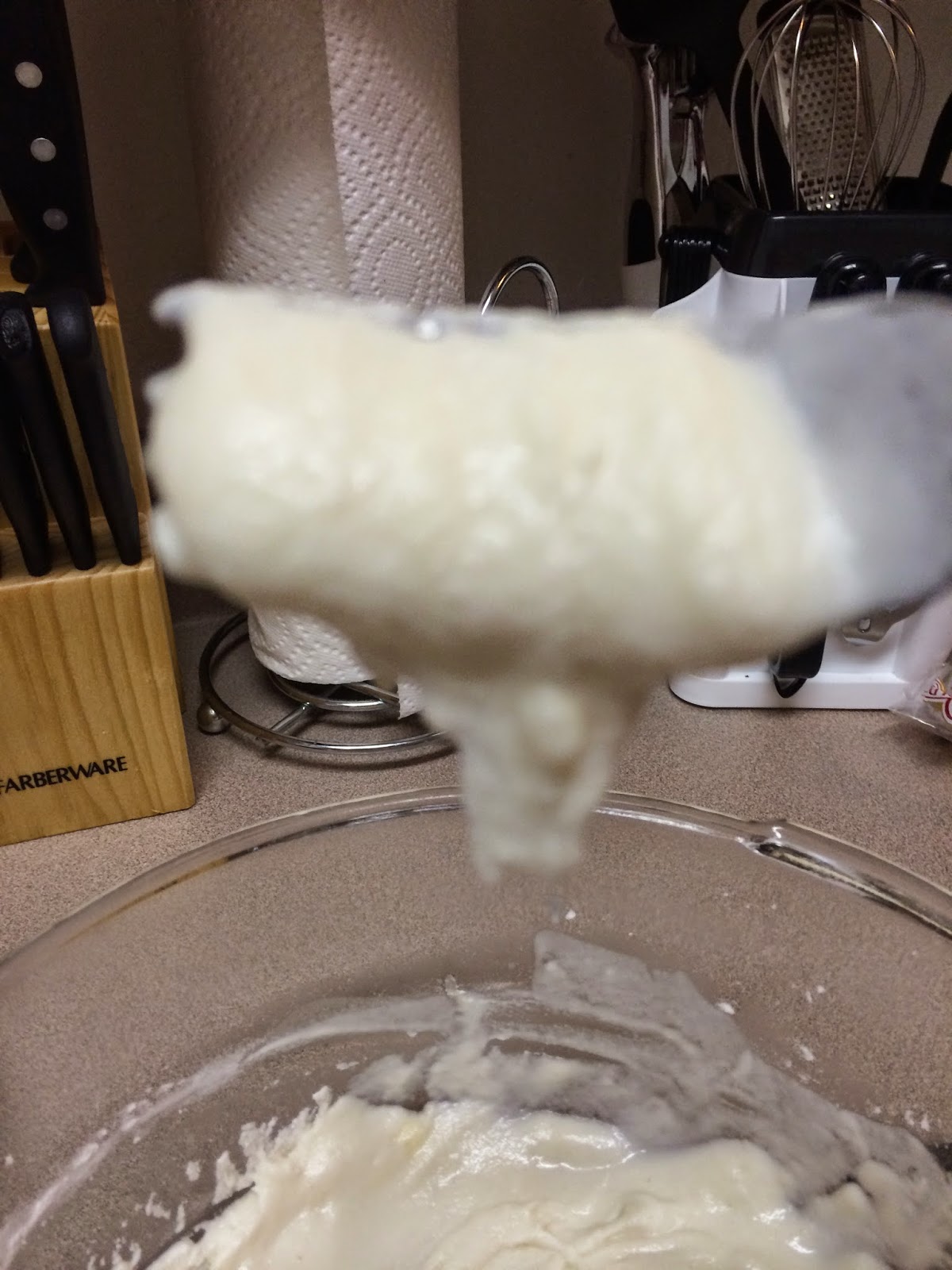 |
| Disaster Strikes |
 I then began on the filling, boiled red bean paste and cinnamon. Prior to opening the can of red bean paste I thought it would be comparable to a raspberry filling. However, once I opened the can I learned that it is just what it says beans in a paste form.
 Next I filled the dough balls with the bean paste mixture and deep fried them in vegetable oil. This also was a new experience, the only thing I have ever fried in oil was chicken prior to today.
 |
| Deep Frying |
 |
| Final Product |
Subscribe to:
Posts (Atom)