Since returning to the United States, I have talked to many people about the trip. Some of the most popular questions include:
"What was the weirdest food you ate?"
"What was your favorite part?"
"What was the worst part?"
"Where did you go?"
"Who did you go with?"
Many more questions follow, but one that makes me the most excited is "What are you going to do with what you learned?" You may think this is weird, but as an educator, I am always striving for more knowledge. If I can share that knowledge, then I am sharing one of my greatest passions.
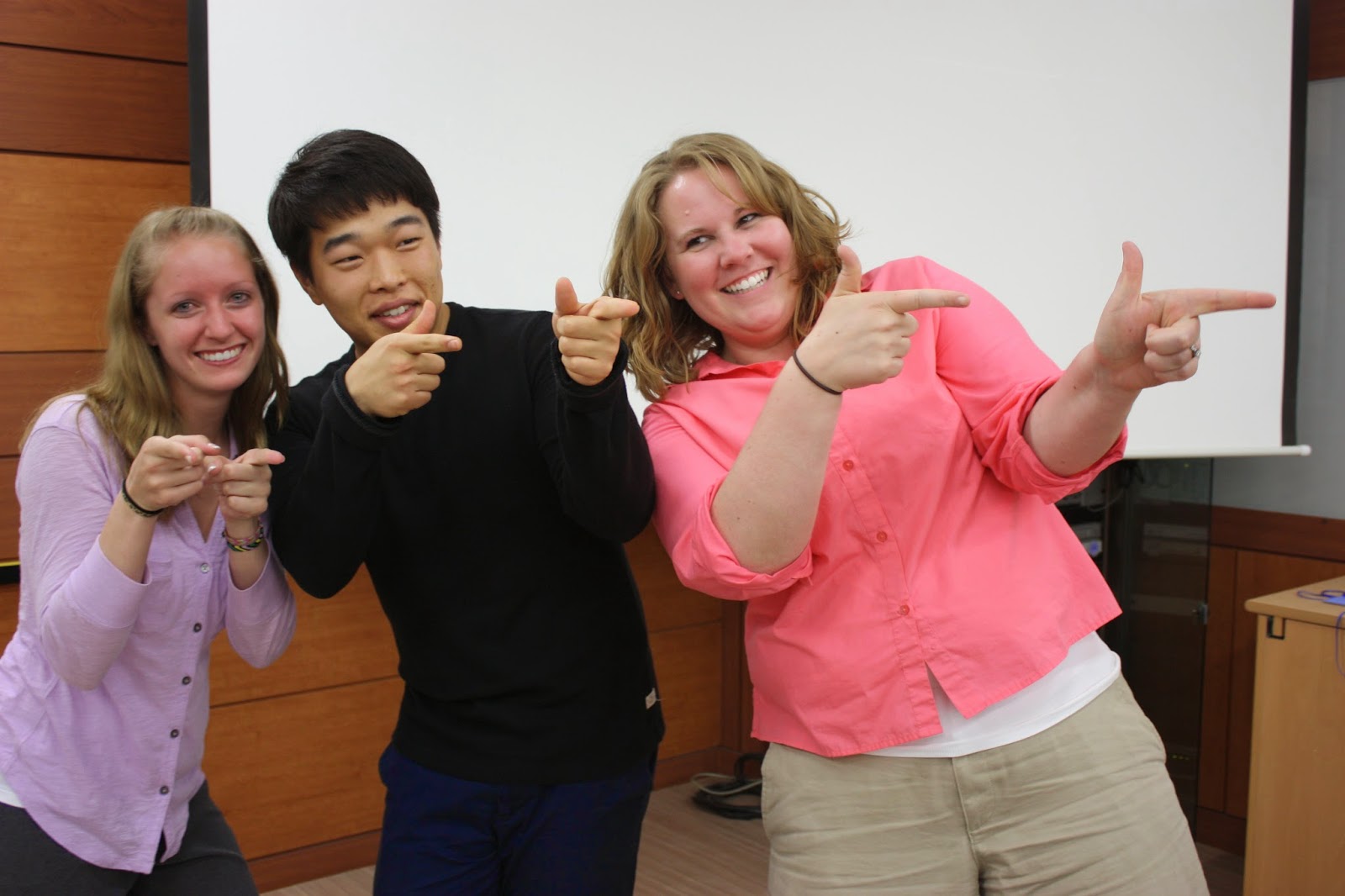
Chris Wilder, Kelli Hamilton and Jason Steward
This week I was able to work with Chris Wilder and Jason Steward again to share our experience with fellow Ag Educators at the Florida Association of Agriculture Educators conference. There were about 15 people in the session. We experienced a great open discussion with the teachers that posed many valid questions.
With the assistance of Jeremy Rhoden, we were able to tie in the experience (global education) to Florida Sunshine State Standards of the various agriculture courses offered in Florida schools. This showed them where it was required that they teach about agriculture on a global scale. But we also shared ideas on how to include global agriculture and global economies in all the courses and levels that we teach.
As an introduction for the session I prepared this video. It was a short something for them to see a little bit of what we did and why we went to Korea. It also started their wheels rolling.
We had a lot of positive feedback from the participants. I am proud to say that at the end of the information session, there was an enthusiasm for the upcoming year and including more global aspects to our curriculum.
Dr. Kirby Barrick, Jason Steward, Chris Wilder, and Kelli Hamilton
If we are to help develop globally competent individuals, we need to be able to relate the things we interact with everyday to the world around us. It is not just about our small community, it never was. We are just a small piece in a giant puzzle. As educators, it is our responsibility to start and continue opening the eyes of our students, to help them realize that, no matter what, we are all connected; if by nothing else than agriculture.
Although we have recently returned to the U.S., we will continue to post
thoughts and stories from #AgEd2Korea participants to reflect on the
breadth, depth and diversity of our experiences in Korea. This
blog showcases some of the answers to the question, "How has this experience helped you grow professionally?"
"I believe this experience has helped me grow professionally in many ways. I think one of the biggest thing was the relationship that I developed with my fellow travelers. I have hugely enlarged my network of professional agriculture teachers that are specialists and I would feel comfortable contacting them for help or advice if needed." - Abby
Cassidy and her teaching partner at Suwon High School
"The chance to microteach was very beneficial. Co-teaching, except during workshops, was something I had never done before. During the actual lesson, we ran into problems that might occur in any classroom-lack of time, cultural/language barriers. I think this experience was a good practice for later on. Since we had more people helping us, the support system was there as well." - Cassidy
"I feel like I am much more comfortable in meeting new people and most importantly, my ability to command the attention of a group. Through the few lessons I taught at Suwon and at Yeoju I have felt like I have improved greatly in my confidence level in teaching. If I can teach a class of Korean students who can’t understand much of what I am saying and they still learn, I think I will feel very confident teaching an English speaking class!" - Stacia
"As a professional educator I am walking away from this experience with
an arsenal of ideas to implement directly into my agricultural education
program as well as a greater sense of social responsibility to develop
my students into global citizens through agricultural education. These
professional growth takeaways would not have been acquired
domestically." - David
Tyler interacts with peers from Seoul National University
"I think I have developed a great deal professionally by adding a large portion of global competency to my skills tool belt. Before this trip, I had little to no experience with other cultures. Now, if I were to work with someone professionally who is from a different culture I believe I would be able to have a much more positive experience. Not only do I believe this would apply to people of different cultures, it would also apply to people of different backgrounds or thought patterns, of which I may be unfamiliar." - Tyler
"This experience has changed me several ways. As a teacher, it has
changed me by having me see that I need to be incorporating more global
concepts into my lesson plans." - Jess
Janae, Kelli and Sarah taking a Korean quiz
"As a professional teacher, I have become more empathetic towards my English Language Learners. After going through the language course here, where I was the language learner, I had all those frustrations, struggles, let downs, and high points that my students experience as they are learning English." - Kelli
"I feel I am more prepared to teach after this
experience. If I can teach a group of Korean students in a different language, I
can teach a group of American students." - Rachel
"As an agriscience teacher, traveling to another country and immersing myself into their culture and studying the agriculture education system has opened my eyes to the global agriculture world. I plan to use this knowledge to share with my students, alumni, community and other agriscience teachers. I know that my students will benefit from this experience as well because it has made me a better teacher." - Jason
Although we have recently returned to the U.S., we will continue to post
thoughts and stories from #AgEd2Korea participants to reflect on the
breadth, depth and diversity of our experiences in Korea. This
blog showcases some of the answers to the question, "What was your most meaningful interaction with a Korean person?"
Deanna and her SNU Teaching Partner
"My most meaningful interaction was with my SNU teaching partner. Not only did he help us with translations and logistics, but he helped us to structure our lesson and make it more impactful for the students in the classroom. He could have sat back and watched as we prepared a lesson but he was engaged and inqusitive the entire time. It makes me wonder how I would have responded in his situation." – Deanna
"My most impactful interaction was when we got to meet the Vice Minister of Education, Dr. Na. I am always excited to meet another OSU Alumni, and one who has made such an impact on the education system, just makes it that much more exciting. He had some very insightful words about finding your passion and dedicating yourself to it. If you are not building your passions, you will not have a very rewarding life." - Kelli
Lesson Planning: Kelli, Hee Song and Janae
"I loved working with my SNU teaching partner, Hee Song. She was absolutely awesome! She really had a presence in the classroom and I really enjoyed being able to team-teach with her. What really surprised me though was the note she left me on our last day together. She wrote that my passion for teaching helped to ensure that she was in the right profession as well. It was an incredible complement and she has impacted me in just the same way."
– Janae
"When I went to Insadong for the second time, as I was shopping I had a group of 13 year-olds and their teacher run up to me and speed quiz me on camera as an English project in order to help them learn to better speak English. They were a great group and they were so excited to talk to me and enjoyed talking to me in English & Korean and it was great to see students that excited to learn new languages." - Amanda
"At Buseong Elementary in Gwangju, I asked a 6th grade student how she was doing and she responded in English by saying, “I am happy!” This was evidence of the successful implementation of the school’s mission statement, which included 'Happy Students'.” - David
Jeremy's class at Yeoju High School
"My most meaningful interaction with a Korean has been with the students
at Yeoju High School. They were so excited to have us in their
classroom and learn about agricultural education in America. They were
the friendliest, most respectful students I had ever met and they made
me want to come to Korea and teach here for a while!" - Jeremy
"My most meaningful interaction with a Korean was when Jason and I were coming home from a late night out on the town and we met Jim, a Korean student from SNU. Jim was very kind, patient and engaging. We met Jim on the subway, we all three walked home even stopping long enough to grab a bite to eat and drink, just like we had known him for years. He even answered his phone to his girlfriend saying he had met some new friends and would be home late." - Chris
Jessica, Cassidy and Abby having lunch with a Suwon Teacher
"My most meaningful personal interaction with a Korean was probably the day that we went to lunch with the Suwon teachers for bugolgi. It was meaningful because although there was a language barrier, we had a normal conversation, just like I would have with my friends. We talked about our school day, what we love about our jobs, and about our family. It was neat to share those things, and I didn’t feel pressure to make sure I was speaking perfectly. They were just happy to interact with us, like we were with them. I wish I would have exchanged contact information with them, a lesson learned, but I really enjoyed lunch that day, and wish we could have had more one on one time with just the teachers. " - Abby
Teaching Team: Stacia, NeungSu and Jessica
"My most meaningful interaction with a Korean is my work with my SNU teaching partner NeungSu. Through teaching together I really had to rely on him to translate to our class. We also had to work on our own communication together for him to be able to help translate. It has definitely helped me realize how to speak more clearly and how to work with a partner in the classroom. Out of the classroom he has also given me a lot of insight into Korean culture. I have had the opportunity to ask him all about his traditions which was
a lot of fun to learn about." - Stacia
I don't think I have eaten in the school's cafeteria since I was in elementary school. It is ironic that today I ate lunch in the lunch room of an elementary school, the first time in so many years!
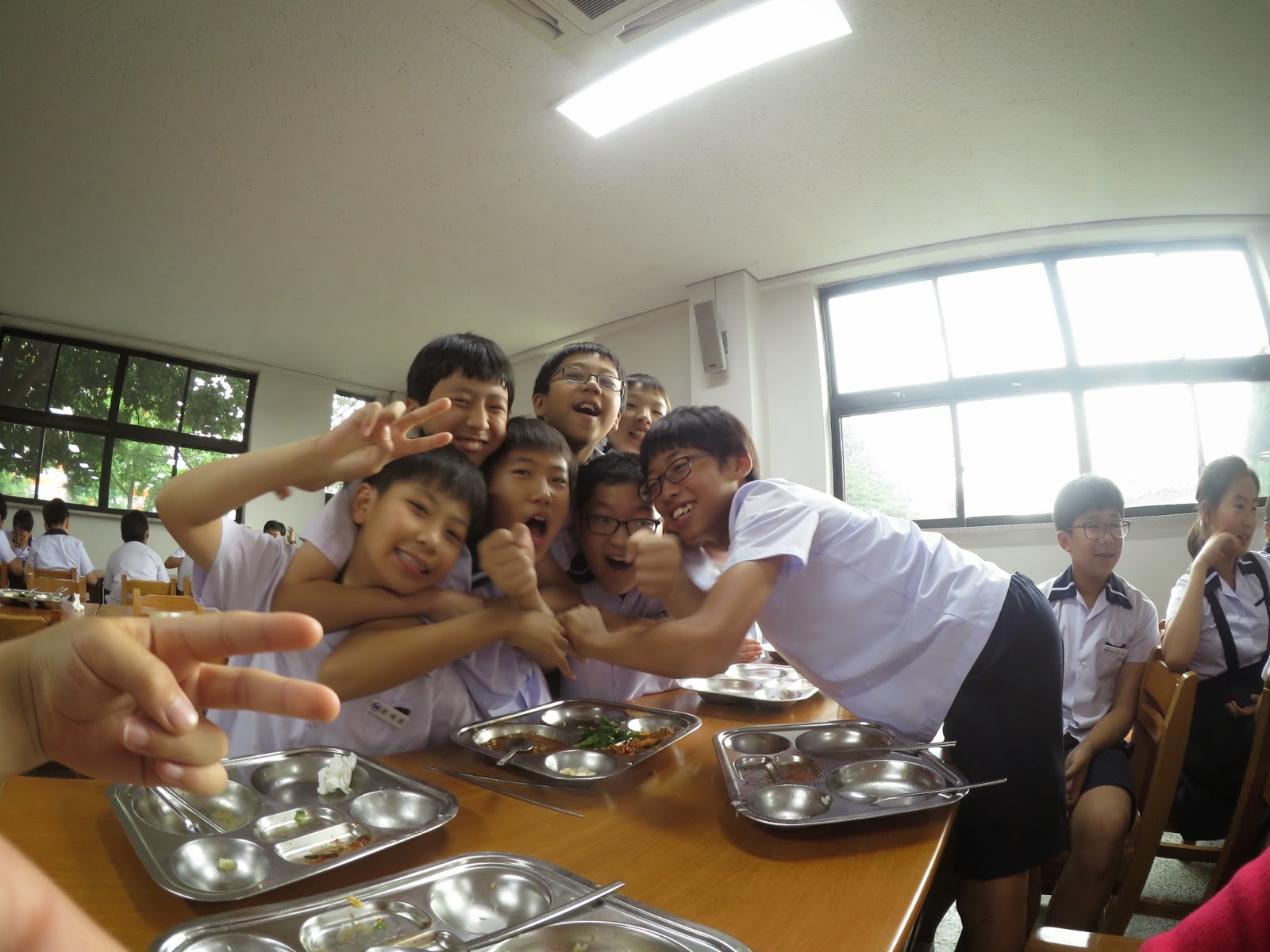
The boys I sat at lunch with.
I have come to the conclusion that boys are boys, no matter the nationality! They spoke English amazingly well! I have never enjoyed a school lunch this much. The boys I sat with were as excited as I was. I know that the other American teachers with me enjoyed the experience just as much.
Today we went to Gwangju National University in the southern province. This university has a unique program that teaches Practical Arts for elementary education. Korea teaches agriculture, technical and home skills in the 5th and 6th grades.
They also have an elementary school that is a part of the university and is a part of their campus. The eight agriculture educators of our group were able to visit this elementary school. We met with the Assistant Principal, saw the school museum, ate lunch with the students, observed a classroom in action, visited their school garden (cared for by the students), and talked to a lot of their students.
School Garden
During their breaks, all students help care for the school garden. Each class has their own section, but all work for the good of the whole garden. The kids seemed to LOVE doing this project. They are responsible for the care of this garden; water, weed, plant, harvest, etc. Every student I saw in that garden (about 25+) had a smile on their face. They were learning the essentials of agriculture at such a young age and in their public school, no less.
2nd Grade Classroom
When we went into their 2nd grade classroom, the students were learning vocabulary and the proper way to use a folding fan. They were so well behaved and precise in the way they responded to the teacher. They truly respected their teacher as well.
We are finishing up day 15 here in South Korea. It is hard to believe that we have been here for such a short period of time, and yet we have experienced so much! We have two weeks to go, and I am looking forward to them.
Today we traveled to Suncheon, Korea via the KORAIL. This was my first time on a train, and I will say it met my expectations. It was a relatively smooth ride, longer than flying and shorter than driving.
For those of you reading this who don't know, I am a Florida girl! We have ant hills and gypsum stacks (the piles of earth that are removed in the process of mining for phosphate). To me, the mountains here are HUGE!!! I enjoy the change of scenery, though. As we were riding the fast train, we were able to see a lot of the Korean country side.
Of course, my camera was not up to the task of taking high-speed images, so this is the panorama picture I took. I feel it covers a good section of what we saw. In the valleys, rice paddies were prominent. We also saw a lot of greenhouses.
We recently learned that greenhouse production is common because it allows a larger variety of produce and crops to be grown through out the year. In the greenhouses I could see in, I noticed a lot of pepper and tomato plants.
I can officially check off "ride a train" from my bucket list. I have successfully road on/in a plane, train, and automobile!
It is well known that by 2050, the population is expected to
reach nine billion, we are currently just under seven billion. These people are all going to have to have a place to live
and food to eat. How is it going to happen? We already have mass shortages of safe,
quality food for the populace today! Within the last few decades, this
has been a real challenge for the agricultural community around the world.
Numerous techniques and methods have been implemented. There is not just one way to help fix the problem of where is our food going to come from in thirty years. From global corporations to small communities, people are trying to change the world we are living in for the better. Monsanto is one organization that has made an impact. Below is a brief informational video from them of the changes they have employed.
While Monsanto, and other companies like BASF, Cargil, Elanco, and many more, are relying on technology to improve the current situation, some believe that the best way is to go back to an all natural approach; no chemicals, no genetic improvements, will minimize the environmental impact.
I am of the opinion that there is no right or wrong way. I feel the answer is somewhere in the middle of the spectrum; that spectrum being a sliding scale. There are a lot of factors that go into becoming "green" or sustainable.
There are many small gardens throughout and very close to the city for the citizens to use. I have seen this in many American cities as well.
While being here in Korea, I have seen "green thinking" to the extreme. Never would I have thought space management as part of being green, but the Koreans have space conservation down to a science. Where I would have thought there was not enough space for a store or vendor, the Koreans have put a stall for a vendor. I witnessed a man selling Jiffy Store-type items in a three feet by four feet corner on the stairs to the subway. As we have walked around the city of Seoul, I am ever amazed that the stores go up, not out. Most of the restaurants we have eaten at in the city have not been on the ground level.
Lotte Outlet Map
Even the malls are different. In America, each store has their own four walls and door. Here, their malls are more like stalls in an antique store or flea market. They optimize space by eliminating walls between vendors. For example, this map shows forty plus stores in the same floor space as the average JCPenney's.
Korean War Memorial
I will admit to being very close-minded when it comes to cities and city life. Having grown up not far from Tampa, Florida, I often saw that the city just wanted to sprawl and stretch out to cover as much land as possible and have as much concrete as possible. Since arriving in Korea, I have changed that opinion. The Koreans are very in touch with the environment and plant life in the city. From having beautiful water ways, to mountains and hiking trails in the city, even hanging baskets of beautiful flower arrangements on the sides of the roadways, they bring in the beauty of nature.
Walking in the Nakeseongdae trails in Seoul.
Today we had the long trek to the National Ecological Institute's Ecorium. On the three hour trip we were able to see more of the landscape and countryside of Korea. The vast portion of the land is mountainous. Every valley is utilized for production agriculture; even to the extent of the road ways being built above the valleys to not take up any space from the crop production.
For being a small country, they have had to implement strategies that will optimize land use and production. I can not help but compare differences of our home to this forward thinking country. They are on the right track in many ways.
Road side on the way to the Ecorium.
I still worry that many consumers are not able to see the benefits of technology in the improvement of our food supply. I recently read an article about going off the grid (electricity grid) in order to reduce one's impact on their environment. However, the state of Florida has ruled it illegal to not be connected to an electricity grid. If someone is able to make a living on limited resources, without exceeding their means, is it right for someone else to mandate their way of life as wrong?
Korea is the home to some of the biggest technology firms in the world, Samsung, LG, Hyundai, Nexon, and many more. I believe that it is because of their emphasis on technology on a global scale, the citizens here are more open to allowing and accepting the changes in agricultural technologies.
I look forward to seeing more of what this country is doing to be green and environmentally friendly. Hopefully I will be able to take what I have learned here and apply it to my home and community.
Our group was smaller than anticipated this morning due to some flight issues, but those of us here were still able to do and see a lot of things. Breakfast was a unique treat for me. We had the options of a traditional Korean, "Healthy Korean," or an American breakfast. I chose the traditional Korean breakfast. I figured, why not give it a try, we will be here for 27 more days, if I like it, keep eating it. If not, then I will be able to try something new.
The picture above is what they served me. The top row of bowls is (L to R) anchovies, a type of radish kimchi, broccoli, and cabbage kimchi. The second row is a fish fillet and scrambled eggs. On the bottom left is a jeonbokjuk (a rice porridge with abolone), sticky rice, and a fish soup.
Fish for breakfast is not normal for us, but it was not so bad. I did enjoy and eat most of the fish, rice, broccoli, and eggs. I have come to the conclusion that kimchi is not for me. I have always been told that it is like a sweeter version of sauerkraut, which I do not like either.
Fun fact for you, abolone is actually a small sea animal. See more about it here. This was in the jeonbokjuk (image on the left above), or rice porridge. Jeonbokjuk was almost bland in flavor and thick in texture. I dipped my fish fillet in it to add flavor to it.
I tried everything except the anchovies (image on right above), although Jeremy did, and he said it was not bad (said with the face of "I am not going to eat much more of it, though."). I am not a big fan of my food having eyes when I am supposed to eat it.
I am proud that I tried everything (except the anchovies). And the best part you ask? I ate it all with the CHOPSTICKS!!!!!!! Fish soup is a new thing to me as well, all together a new thought for me. It was not bad, just different.
Jeremy, Melanie and Abby were discussing what all we were experiencing.
I love to read; I have since I was very little. This quote resonates with me on more than one level. There is so much to the world that we do not know of. Many don't even have the desire to want to read past the page they are on.
Both of my parents are Agricultural Educators. Growing up, my two older sisters and I said we would NEVER be a teacher (now two of us are ag teachers). We saw what all our parents went through and the challenges they faced on a regular basis. As I was completing my senior year at The Ohio State University, I was faced with the same questions every graduating senior asks themselves, "What am I going to do with my life?!" As I started to evaluate my passions and desires of life. And would you believe, my two greatest passions are agriculture and education? It was pretty much instilled in my since birth (Momma and Daddy started teaching in 81-82 and I was born in 88). I truly enjoy teaching and the kids are great!
However, there are some things that this small town can not provide me. Travel. I get antsy and want to just GO! Now, if someone could combine my love to travel with my two passions, I would be the first one in line! So here I am!!
I grew up in Central Florida raising cattle. This picture is of my niece and I in the cow pens at our family's farm in Bushnell, FL. I am lucky enough to be able to live on this farm now and have cows in my back yard. I now work in Dade City, which is about 20 minutes south of my house. I love the drive because it gives me the time to gear up or wind down from the day. You would be amazed how much planning can go on in 20 uninterrupted minutes. I am in a two-teacher department with about 70 members. I am proud of the community and the kids here because of the rich agricultural history they represent.
I am looking forward to this trip. I get butterflies just thinking about it now, I think I am in love.... I can't wait to get to know all of you more as we all partake in this adventure of a lifetime!