Showing posts with label similarities and differences. Show all posts

Wednesday, September 3, 2014

Impact Presentation: Nonnewaug High School Faculty and Staff

Today I presented for about a half hour to the faculty and staff of Nonnewaug High School, which included teachers from all subject areas, Guidance staff, administrators, and Library staff, for a total of approximately 80 people.

I started out by asking the staff what came to mind when they heard the word "Korea."  Answers ranged from anything related to K-Pop, to things they had heard in the news regarding North Korea. It was interesting to hear what they had to say, especially since more than one person had confused my trip for having been to Japan.  I think it was useful for me to include a picture of the world map to help them orient themselves.


As far as the general theme of the presentation, I tried to focus on not only what we learned specifically about Agricultural Education, but also about general education in Korea.  I also emphasized the mentoring experience that we engaged in.  It seemed to tie in particularly well with what we had been discussing in our Professional Learning today, since we were going over the new Teacher Evaluation Rubric from the Connecticut Common Core of Teaching. 

One of the areas that we are assessed on is "Professional Responsibilities and Teacher Leadership."  In order to demonstrate an exemplary rating, one must "Participate actively in required professional learning and seek out opportunities within and beyond the school to strengthen skills and apply new learning to practice, as well as taking a lead in and/or initiates opportunities for professional learning with colleagues."  It seemed that what our practice in Korea was doing, was helping to model a method of Professional Learning that could be implemented in the U.S. as well.

Much of our Professional Learning today was centered on "data-driven decision making", "research" and lots of number crunching.  When presented with this information all day, it can be extremely overwhelming and daunting to feel motivated about the craft of teaching.  I emphasized the focus that South Korea is placing on "Happy and Creative Education for All" as a way for us to re-center our learning on the art and passion we all have for teaching.  I felt that the staff responded in a very positive fashion and they seemed to enjoy the presentation quite a bit!

Questions asked include the following:

1. What do people do for recreation in South Korea?
2. With all of the emphasis on intensive hands-on instruction, how many students go on to pursue a college education in South Korea?
3. What is South Korea's stance towards GMOs? (Genetically Modified Organisms)
4. When you were planning your micro-lessons, did you bear in mind the "Happy and Creative Education for All" as a guiding principle for lesson planning?

I really enjoyed the opportunity to present to my fellow staff members.  I had the unique chance to teach fellow teachers about agricultural education through another lens.  We have a lot of new staff at our school, so not only did this teach them about Korean Ag Ed, but also Agricultural Education in the US. 

While I was answering the 4th question listed above, I had the opportunity to share the "nugget" of information that we formulated while at Yeoju: "Good teaching for English Language Learners or other students with learning needs, is good teaching for all students!"  I emphasized the need for planning that doesn't focus exclusively on hands-on activities that are fun just for the sake of making students happy, but also for them to be "hands-on, minds-on."  Frequently Agriscience classes may have the misconception that they are just classes for kids to "go play in" without learning any meaning behind the activity they are performing.  This discussion was the perfect platform to help dispel that myth.


Sunday, July 6, 2014

Only Human...

During this trip we have gotten to do a lot of really cool things to learn about not only Korean Agriculture Education, but also Korea's cultural heritage.  We have traveled to cities and countryside, by trains, planes, and buses.  We have met students of all ages; elementary, high school, and college.  We have toured government agencies, cultural landmarks, schools, villages, cities, forests, and farms.  It has been a completely AWESOME experience!

Throughout this trip, we have focused a lot on learning how Korea does the business of agriculture education.  I think in my own mind, I have come to this learning experience from the vantage point that I was going to be seeing things that were very different from what we know at home, not only with Ag Ed, but culturally as well.  It is very easy to focus on all the things that are different from our own experiences.  There's a few things that are different here than home, that I've found it a little challenging to adjust to:

-Napkins that are the size of what we would call "cocktail napkins" as your only napkin during a meal, if any.  I am used to having one that folds out and is placed in my lap, so eating without getting food on myself has been a real challenge!

-Very small cups of water with a meal, but usually only consumed at the end of a meal.  I like to drink water throughout a meal, especially when the meal is spicy, but this is considered "bad for digestion" in Korea.

-Minimal trash cans.  There are hardly any of these in this country!  The streets are usually very clean, so I am not quite sure where people throw away their trash, but there isn't a lot to be seen.  Just tonight, we had ice cream in a Baskin Robbins (yes like the chain from the US), and when we went to throw away our cups, there were absolutely no trash cans in sight...turns out the staff behind the counter will gladly take them off your hands.

There are tons of other things we could go on to list that are different between Korea and the United States, but what I've come to see increasingly clearly, are the things that are the same between our two cultures.

Both Korean and American college students preparing to be teachers share similar reasons for why they wanted to be a teacher:

-"I've known since I was 6 years old that I wanted to be a teacher.  This is my dream!"

-"I had a great homeroom teacher in 6th grade that was my favorite teacher of all time.  I want to be a teacher because of him.  I hope I can be that kind of teacher too."

-"I had a wonderful experience through my agriculture education program in high school, and I wanted to provide the same opportunity for other students."

-"I had the opportunity to help teach a class, and I loved it!  That inspired me to become a teacher."

Looking at the responses above, I'll be you couldn't identify which statements were from Korean students and which are from American students!

Korean Ag Education Graduate Students. The student closest to me wants to be a landscaping teacher!


It's not only the outlook on education, but who we are as people.  Walking around the streets of Seoul, you will see A LOT of people.  You become very aware that you don't look like most of these people if you are not of Asian descent.  But as you peer a little closer, you start to notice the similarities:

-Old and young couples hand in hand, many times wearing coordinating outfits.

-Young children squealing in delight over playing in the water fountain.

-Parents scurrying after their child who just escaped their grasp.

-Groups of old women cackling together.

-Friendly Samaritans, who stop to help us find our way in the subway system.

-Giggling adolescent girls, just getting their first taste of independence and "fashionable" clothing, makeup, and perfume.  

-Happy, content children, eager to see their teachers or principals.

-The high school cliques: jocks, nerds, quiet kids, popular girls..the list goes on.


Families walking along the street in Insa-Dong


I could keep listing these things but this blog post would keep on going!

Today I had the opportunity to share a delicious meal with Robin, one of the teachers we met at Suwon, and Kelli.  Robin brought her 2 year old daughter along with her, and the four of us had a lovely lunch together.  We come from very different parts of the globe, but ultimately we all came together and spent time together, not necessarily to learn more about the other's culture, but to share each other's company as people.  

Kelli, Me, Robin, and her adorable daughter!


Because really, despite the differences in culture, history, food, location on the globe, we really are all people.  We are all connected as members of the human race, and even though we are halfway around the world from each other, we really aren't all that far away.  We all share this Earth together and want to see our families and friends learn, grow, and love.  

There are lots of barriers to international relations between countries.  I think the first step in getting over our differences is to realize that we are all in this together.  As humans.  On this one place we call home, Earth.  

Friday, July 4, 2014

What's Your Mission Statement?

Imagine someone walking up to you on the street and asking, "what's your mission statement"?

What would you do? How would you respond?


Unfortunately, this is how I often feel the leaders of some schools, agencies, and professional organizations in the United States would respond as well.

No matter what entity we visit in Korea, however, the representative with whom we meet is quick to confidently tell us the mission of their organization. Most impressionable was the mission of Buseong Elementary School, which we visited in Gwangju this week:

Happy Students, High Expectations, and Passionate Teachers.

Now, that's powerful.

Let's take a moment to reflect on this mission statement.

Happy Students
Happy students learn better, according to Vice-Principal Lim Yong, therefore the most important facet of their mission statement is focused on student-centered learning.  This was evidenced by a conversation with a sixth-grade student while working in the school garden.  I asked her how she was doing today and she replied, "I am happy!"  Does your school focus on students and student success? And if so, are your students happy?

High Expectations
When students are challenged with a rigorous curriculum and high expectations are set, they confidently challenge themselves to work hard and meet those expectations.  This is evidenced at Buseong Elementary where, besides World Language and Fine Arts, students are exposed to Practical Arts in Grades 5-6.  How are you holding your students accountable to high expectations?

Passionate Teachers
It takes a passionate teacher to dedicate themselves to the profession, often spending hours before school, after school, and on weekends grading/planning, working with students, and perfecting their craft.  Teachers who feel supported, valued, and appreciated as professionals in their field will be more passionate about their jobs.  At Buseong Elementary, teachers spend one hour before school each day collaborating on lesson plans and refining their skills through teacher-led professional development.  When is that last time you felt valued as a professional educator?  Is your passion evident to your students?

In summary, a mission is a statement of purpose, a reason for existing.  I have shared just a single example of a little elementary school in Korea whose mission is simple; happy students + high expectations + passionate teachers = SUCCESS

What's your mission statement?  Whether it's a personal or professional one I challenge each of you to have one and live by it every day to not only be more successful yourself, but to have more successful students.

Thursday, July 3, 2014

Future Farmers of Korea!

Prior to this trip, I had never heard of the FFK (Future Farmers of Korea). I consider myself to be an all out FFA nerd, and was extremely excited to hear that we would be meeting with representatives of the FFK!

I had the fortunate opportunity to meet with FFJ (Future Farmers of Japan) students while at National FFA Convention this past fall, and it totally made my student's day. They didn't realize that the FFJ existed, and were elated to hear that other countries around the world had an organization similar to ours.

When I was in FFA in high school, I had heard of a Future Farmer Organization in Bosnia and read about the FFJ in the New Horizons Magazine, but never of any others.

         
      My students at National FFA Convention 2013, ELATED to meet the FFJ!!


So, when our group traveled to Korea, I was eagerly awaiting the opportunity to meet with the FFK. This past Friday, we finally got to learn about FFK!  During our lesson presentation earlier in the week we talked to students about FFK, and it turned out that the Suwon FFK Chapter President was in our class, which was really cool.   I thought that since school was currently in session that we would have a presentation on FFK from student members, but it ended up that teachers and FFK staff presented to us instead. We got to watch a presentation about the basics of FFK, and also ask questions about it at the end.  Here's some of the highlights of the presentation:

-All agriscience students can be members of the FFK, pending that they pay their annual dues of 3,500 Won (about $3.50).

-Upon paying membership dues, students receive their membership pin and a newsletter.

-Students can participate in regional and national skill competitions.  These include baking, landscape design work, and floral arranging, among many others.

-There are 71 schools that offer FFK as an option for students to be involved in.  These 71 schools are grouped into "chapters", with 14 chapters total. In the FFA, a chapter is located at the local level, with each high school or middle school having their own chapter. When we asked for clarification of the 14 chapters, it sounded as though they were regional groupings, like our FFA state associations. These chapters are formed based on membership, so some chapters are located around cities and only include students from that area since there is a more dense population, while others are entire provinces. 

-The country is divided into 4 FFK regions, modeled after the FFA regions: Western, Central, Southern, and Eastern. A National Officer Team exists, and is comprised of a National President, and 4 Regional Vice Presidents, one for each region. Th National President can only be elected from the previous year's Regional Vice Presidents.  This year's National FFK President is only a Junior in high school!

-The National FFK Convention rotates its location each year, with various high schools around the country hosting it each year.  Suwon High School for Agricultural Sciences will be hosting it this coming September. 

-The National Convention attracts about 1,000 students and has 2 major parts:
  1. Skill competitions & Election of Officer
  2. Entertainment
  We got to see a highlights video of their National Convention and these students really get into the fun they have! We saw a wide variety of talent displayed, and part of one of the most popular contests, the Golden Bell.  This is basically a survival quiz about various agricultural knowledge and students compete individually, writing their answers on a hand held white board. If they get a question wrong, they are knocked out and the last student standing wins.

-There is no official dress, but at National FFK Convention, students wear polo shirts representing their chapter or school. 

                                          
                                         We were all given our very own FFK membership pins!!

I was also really interested in learning about the FFK emblem.  Our FFA emblem is steeped in tradition and symbolism so I was curious to see if the FFK was the same. It seems there is some symbolism, but som of it is unclear. The 2 dots at the top of the emblem represent the eyes of leadership and the flower-like design below the dots represent the creative energy of the youth.  From what I could gather, their colors were green and gold. 
 
                                         
                                             Clearly, I am stoked to be learning about the FFK!

We asked our presenters what they felt the biggest challenge for FFK was.  We found that they battle similar stereotypes that we sometimes do in the US, regarding the image of an agricultural life and career.  Many students in Korea don't necessarily find agriculture an appealing industry to work in because they don't think it has prestige and is a lot of hard work. FFK is working to change that by offering a more diverse array of activities to help develop leadership. I'd say that we as FFA members and advisors, we also are continuously presenting ourselves in a variety of formats to reach a more diverse array of students. I was impressed to hear that the FFK boasts a national membership of 22,994 members! Along with all of the leadership opportunities and skill development events, FFK members are also given the opportunity to work with a mentor farmer, ones that are considered innovative.  What a great way to involve the industry by pushing your bright stars into the careful guidance of those who are currently leading the way in agriculture!

I think it would be so cool to have a partnership with FFK and FFA. I also learned that there is a Future Farmers of Thailand too! Think of all the opportunity that our students could have by developing a cooperative relationship with these other parallel student organizations. 

If you would like to learn more about the FFK, check out their website.  I especially like their Creed, which is very similar to the FFA Creed.  Check it out!
 

It's All About Connections

Agriculture Education is all about connections.  Connections to the agriculture industry, connections to the community and it's members, connections with other Ag teachers; Ag teachers are constantly working with other people to rock out some incredible lessons.  Teachers also have connections with other teachers through professional organizations like National Association for Agricultural Educators or other state associations.  As pre-service Ag teachers, we have the opportunity to be involved in some of the things that the organizations do; go to meetings, events, etc., all very helpful for building our professional network.

But what organizations, what camaraderie, is out their for pre-service agriculture teacher candidates?  We have Teach Ag! Society chapters, even Collegiate FFA, but it is not very often that we connect with other teacher candidates outside of our own university.  Are their even other groups like the Teach Ag! Society?  Are their any other collegiate-level  advocates for agriculture education?!


The answer is yes!  There are other Ag Ed students out there just like us!  We were introduced to an organization at Sunchon National University in Suncheon, Korea for students studying agriculture education.  The explanation of the group was brief, but definitely left me wanting to know more!

The organization is called 논두렁, or "Non-do-rung", and is very similar to Penn State's Teach Ag! Society in that students studying agriculture education spread the word about agriculture and the importance of teaching it in the classroom.

Over the two days that followed the presentation at Sunchon University, I learned more about the significance of the organization's title that just blew me away.

The word "논두렁" literally translates to "levee" and is used to describe the pathways that connect rice field to rice field.  Let's just talk about the significance of this name.  The most obvious connection is that rice is a staple crop of the Republic of Korea so including such an important part of Korea's agricultural history and presence in the name of the organization is awesome.

Secondly, and the part that I found to be most fascinating was word "pathways".  Do we not as members of Teach Ag Society and 논두렁 create pathways to connect the significance of agriculture with the public?  Do we not help students find the pathway to understanding where their foods come from?  I thought that using a word that means connecting one area of agriculture to another was a clever, and all too perfect, way to sum up our collegiate agriculture education organizations.


One of the most impactful things I have learned on this trip is that we, as pre-service teachers and argicultural advocates, are not isolated in the world.  There are other groups like us even on the other side of the world.  And doesn't that open the door for a whole different world of global opportunities as an agricultural educator?

Wednesday, July 2, 2014

Cafeteria Lunch

I don't think I have eaten in the school's cafeteria since I was in elementary school. It is ironic that today I ate lunch in the lunch room of an elementary school, the first time in so many years!

The boys I sat at lunch with.
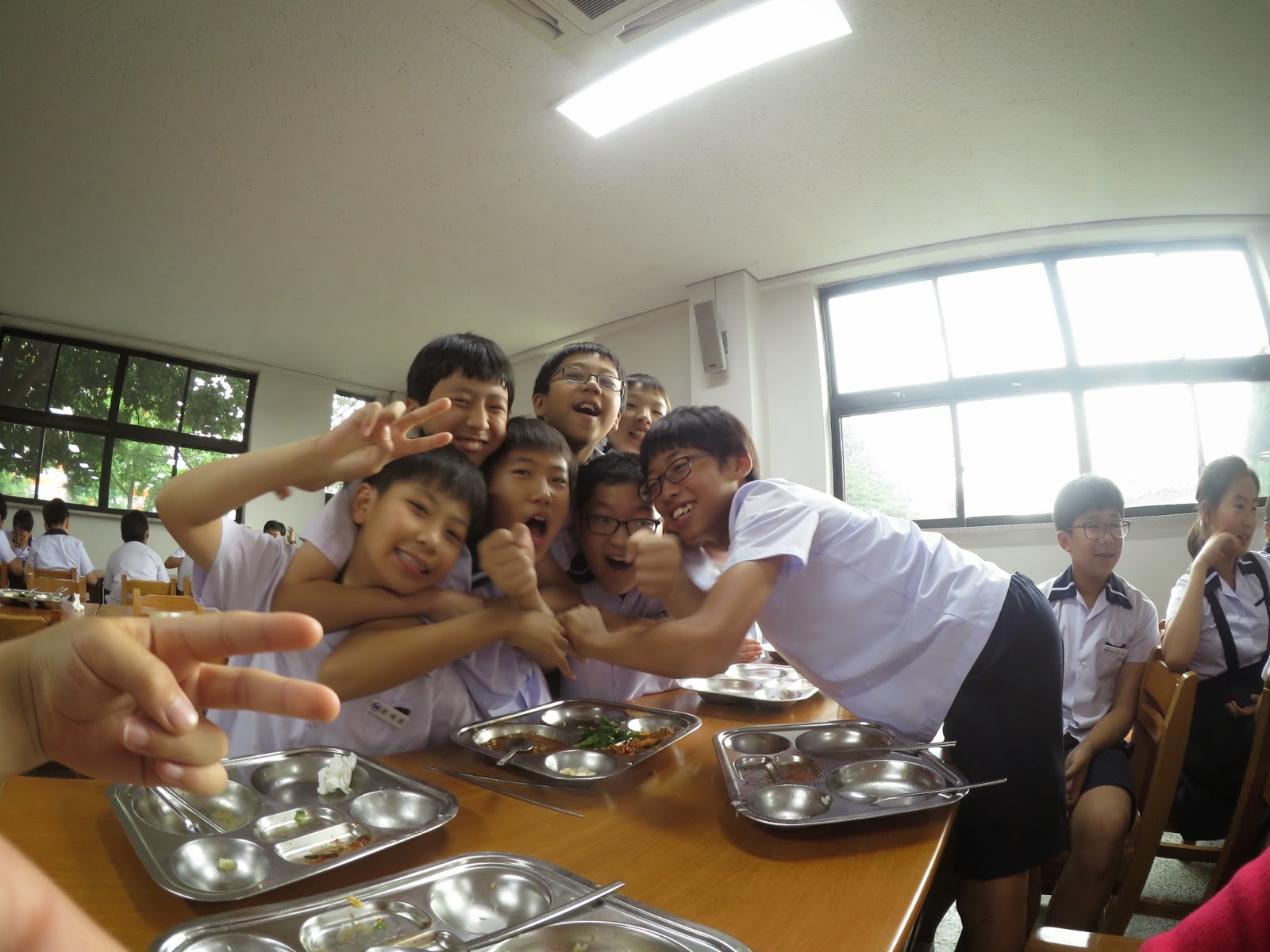
I have come to the conclusion that boys are boys, no matter the nationality! They spoke English amazingly well! I have never enjoyed a school lunch this much. The boys I sat with were as excited as I was. I know that the other American teachers with me enjoyed the experience just as much.

Today we went to Gwangju National University in the southern province. This university has a unique program that teaches Practical Arts for elementary education. Korea teaches agriculture, technical and home skills in the 5th and 6th grades.

They also have an elementary school that is a part of the university and is a part of their campus. The eight agriculture educators of our group were able to visit this elementary school. We met with the Assistant Principal, saw the school museum, ate lunch with the students, observed a classroom in action, visited their school garden (cared for by the students), and talked to a lot of their students.

School Garden

During their breaks, all students help care for the school garden. Each class has their own section, but all work for the good of the whole garden. The kids seemed to LOVE doing this project. They are responsible for the care of this garden; water, weed, plant, harvest, etc. Every student I saw in that garden (about 25+) had a smile on their face. They were learning the essentials of agriculture at such a young age and in their public school, no less.

2nd Grade Classroom

When we went into their 2nd grade classroom, the students were learning vocabulary and the proper way to use a folding fan. They were so well behaved and precise in the way they responded to the teacher. They truly respected their teacher as well.


We had a memorable time. 


Tuesday, July 1, 2014

Rice, Rice and More Rice

Not only is there rice with almost every traditional Korean meal, but there are rice patties scattered across the country side everywhere you go. This being said, rice is Korea's staple production crop, and we were fortunate enough today to get some insight knowledge on the production and pest management practices used.

Rice is grown in paddies, and while there is not a size measurement that governs this term, it is simply the water-filled area where rice is grown. This is very similar to a field in the United States, simply an area that is cultivated for a crop to be grown.

What is not so similar is the pest management practices utilized. Though we do have a small percentage of our crops grown organically in the US, that is not the norm, but in Korea rice is all grown organically! Of course, we immediately questioned the possibilities of this, and man, did we learn a lot.

To begin there is one main predator of rice: mice. The mice are largely taken care of by the water that the rice is grown in, at least until the paddy is drained before harvest.

While examining the rice patty we noticed hundreds of small pink objects that resembled flowers at first glance,  we came to find out that these were snail eggs. In each rice patty hundreds of snails are released to feed on the weeds. This method takes care of about 50% of the weed problems and the rest can be managed by hand weeding.

Next we inquired how they take care of insect pest problems, and the answer was ducks. In a one hector patty they will release up to 300 ducks to patrol the patty for pests. Then when the rice crop is harvested they also harvest the ducks and sell them. We took this as Korea's form of double cropping. What an awesome way to utilize management practices and be environmentally friendly.  Unfortunately, the avian flu virus outbreak has limited this practice recently.

There are so many interlinked agricultural businesses working together to create this staple crop of their nation, which is amazing to see and experience!


Monday, June 30, 2014

One-of-a-Kind Classroom Experience

Imagine going to high school knowing once you graduated you would have a job, no debt from college loans, no stress in not knowing what to do once you got a college degree, no delay in starting a career. How awesome would that be? 

Here in the Republic of Korea students are given a chance to step away from the mainstream of universities and have the chance to step out of their secondary school (high school) with a certificate in a technical skill and have a job waiting for them straight out of high school. 


One of the race horses produced
by the school
The Meister school system is a new take on traditional education. After middle school students currently have the option to apply to one of 35 specially designed trade schools known as Meister Schools. The application process varies from each one however academic grades are necessary. Studies are showing that up to 50% of Korean graduates are unable to find full time jobs in their field of choice creating an overflow of over-qualified workers into the blue collar workforce. Meister schools are taking on the duty to provided highly qualified workers for certain trades. One of the ways a Meister school ensures that all students have a career is they only allow as many students in as the job market allows for. That way the demand is met with out over-flowing the job market with a large supply of workers. 


Look at that view!
One of the horses in the school's
breeding programs.
The Korea Horseman High School was one of our stops today. The school had breath taking facilities, friendly educators, and eager students. Being the one and only Equine Industry Meister High School in the Republic of Korea this Meister school is truly one-of-a-kind. 

After a short video presentation we got a real feel of what the school was all about. We took a quick tour of the facilities and got to meet a few of the 85 students. 

The most shocking detail of the school's population for me was that out of the 85 enrolled students only 19 were females. This means on average there are 5 girls in each of the four grade levels. After learning more about the culture as well as the application process which includes two parts physical fitness and academic success it became clear why their were mainly male students. Looking towards the future like most the school is currently undergoing construction to add female dormitories. At this time the equine industry is not very demanding in the Republic of Korea, however the opportunities for employment around the globe are in high demand. The school is looking to expand and grow at this point in time for every three students who apply only one is excepted into the program.


Students giving their horses a bath
after the classroom instruction!
Watch the video below.
The Korea Horseman High School originally opened its doors in 1969 as an animal husbandry school and after the rural population decreasing and the need for the school enrollment dropped drastically. The school went through more changes and then in 2012 became the 7th Meister school to open its doors specializing in the equine industry. 
  
Reflecting back on our adventure today I would really enjoy seeing more schools like these in the United States. How cool would it be to go to a school to a high school where you learned how to train horses, manage your own breeding facility, or learn the skills to become a farrier, or equine therapist? All of these career paths are offered here to students giving them hands on experience for the careers they desire! 

For more information on the Meister school we visited Click here 

And for a quick read on the education reform in the Republic of Korea


Now this is my kind of classroom! Students ride
about 2-4 hrs a day, this is the open
classroom the teacher in the middle gives instruction to his small class


Finding a Home Away From Home

These past two weeks have just flown by, and the pace is not slowing down for the second half of our adventure. We have learned so much about Korea's culture and agriculture, and we've all experienced a lot of "firsts" - from riding a cross-country train, to learning (or at least attempting) the Korean language, getting our fill of spicy foods, and even enjoying some karaoke with our friends from Seoul National University. But amongst all of these new experiences, the highlight of our #AgEd2Korea adventure for me so far has felt like both a "first" and like coming home - our visits to Suwon High School for Agricultural Sciences!

Suwon is the first of our agricultural high school visits and luckily here we were able to split our visits up into three days, which allowed us to tour all of the facilities and micro-teach a lesson of our choosing in two different classes. It was a great time. Suwon has been the highlight so far for me because it is so different yet so similar to my school, WB Saul High School for Agricultural Sciences in Philadelphia, PA.

Student Landscape Design Greenhouse

At Suwon the students are divided into three major tracks - plant science, food science, and mechanical sciences, where the students then more topic specific courses as they advance through school, very similar to the plant science and animal science tracks at Saul. The facilities at Suwon are amazing, and again I could find similarities. Suwon has dozens of greenhouses which it utilizes for various student projects, such as bonsai trees, individual student landscaping displays, and student driven research. There are many large food science labs inside the school, to allow space for all sorts of cooking and baking experimentation. There are also mechanical shop buildings, filled with any shop equipment you can think of from welding hoods to tractor repair areas. They even had a rice harvester!

While Saul may lack some of the facilities available at Suwon, there was a common theme among both schools that I really enjoyed - partnerships. Community partnerships are very important to Suwon High School, which aligns with what we have learned about the importance of cooperation and teamwork in the Korean culture. At Suwon these partnerships are very visible in the amount of community volunteers we saw on-campus. While students are in classes, community volunteers work in the shops and greenhouses, maintaining the shops and greenhouse projects. We saw volunteers working on large-scale flower arrangements for an upcoming festival which came about through the partnership the city of Suwon has with the school.

FFK Emblem Banner
Students have regular school hours from 8am until 4pm, then from 4pm until 6pm is dedicated time for the students to work on their individual projects, work with clubs and other student organizations like FFK, and also time for students to receive extra instruction from graduates of Suwon High School. These graduates come back to the school after work to provide the current students with real-world knowledge and skills they have gained in the work-place as a way to "pay-it-forward" to the next generation.

The importance of community partnerships is vital to any program but I think it was returning graduates helping at Suwon that reminded me of Saul the most. While we also have partnerships with various agriculturally-related businesses in the area, such as the Community Supported Agriculture (CSA) we operate on our property, allowing community members to purchase fresh food from the school, similar to the market Suwon operates, we also have many alumni involved with our school who want to "pay-it-forward." I am just one of many alumni who help chaperone school trips, work with students in preparation for shows and competitions, and come out to support the school at banquets and other events.
Chicago HS Hat. Soon a Saul Hat?

I think that Saul and Suwon have a lot in common with each other and could learn a lot from each other. Another aspect of community partnerships that was really fascinating to me was that Suwon expands their community internationally, with exchange programs with Future Farmers of Thaliand (FFT),  Future Farmers of Japan (FFJ), and with the Chicago High School for Agricultural Sciences in the U.S. Since they already have an established relationship with Chicago, I would love to help develop a relationship between Saul and Suwon and hopefully eventually between Suwon and my future agricultural education program, wherever that may be.

Thursday, June 26, 2014

Variety is the Spice of Education


One bonsai tree present in the greenhouses

Baskin-Robbins is famous for the variety of flavors that they offer their customers.  You can show up at a Baskin-Robbins and sample dozens of flavors before you reach the perfect one for you.  Take any group of people out for ice cream one day and really pay attention to what each of them ends up ordering, chances are they will not all get the same thing.  Take that same group out to an ice cream place which only offers chocolate, vanilla, and strawberry and you'll see that, while they may all get something, they may not all be completely satisfied with what they received.  

Suwon High School is amazing at offering students whatever flavor they want.  The school's facilities are impressive to say the least, they have multiple greenhouse, workshops, garages, and open student workplaces.  These are all then utilized by the students in their project based learning experience.  

This area is used by students to repair farm machinery
The most impressive part about these facilities is how they are utilized to enhance student engagement.  At the end of every school day (at 4:00 PM) students are required to participate in a structured activity until 6:00 PM, almost like an afterschool club in the US. 

We had an opportunity to tour and explore the product of many of these student projects and the results spoke for themselves.  I saw entire landscapes, beautifully grown bonsai trees, and entire restored tractors.  Not only that but there was also plenty of evidence of student learning going on; there was a cleared out area used to practice safe tractor driving, an area where transplanting was obviously taking place, and a workshop filled with welding rooms and evidence of practice welding.  Practical application of student knowledge was ever-present in our tour of the school.  

A product of the student run greenhouse gardens
The other amazing part of these student projects is that they mostly occur in groups.  Back home, we have student run projects (Supervised Agriculture Experience projects) but they occur almost entirely on an individual basis.  However, the culture that is present in Korea is such that the success of the group is always emphasized over the success of the individual.  I would absolutely love to see what would happen if a concept such as this were adopted in the US; what sort of projects would come out of the labor of multiple FFA members rather than just the work of one?

It's when we view things like this that really resonate with me.  We have a great system in the United States for Agriculture Education but it can always be better.  We all need to be on the constant lookout for tricks, tips, and tactics we can incorporate to encourage further growth in our industry. 

The Programmatic View - Experiences at Suwon High School for Agriculture Sciences


The past two days have been inviting, exciting, challenging, and mind altering. We have finally reached the point in our trip in which is one of the main reasons for traveling here. 

We have enjoyed two full days touring and teaching at one of the most prestigious agricultural high schools in the Republic of Korea, Suwon High School for Agriculture Sciences. Suwon High School is one of three major types of high schools found in the Republic of Korea. It is considered a technical high school, similar the career and technical high school programs that can be found in the United States. Throughout today’s post, I would like to give you a little insight as to the student life at Suwon, as well as define some major highlights that all of us were able to take away from this extraordinary program.

Student Life

Student life is somewhat different from what some of us envisioned going into this program. Some students at Suwon High School reside in the on campus dormitories, while others live at home and commute. 

The high school has three grades at the high school level, known as grades one, two, and three. Obviously this differs from the United States because we are used to labeling grades from first to twelve. Students in Korea complete grades one through six at the elementary level. They complete grades seven through nine at the middle school level. (These grades start over and are known as grades one, two, and three.) They finish their schooling with grades ten through twelve at a high school which is chosen based upon their grades and review of a submitted application. (These grades also are known as grades one, two and three.). 

Students in Korea, upon completion of primary school, apply for and choose whether they want to or are able to attend a Meister school, technical high school, or common high school. All schools are different, based upon the students within them and their future career paths.

A typical school day for students at Suwon is as follows: Begin the school day at 8am. End the school day at 4pm. Participate in mandatory club activities until 6pm. Eat dinner. Attend free study sessions at school from 7pm to 9pm. If desired, attend dormitory study sessions from 9pm until 11pm. 

You are probably thinking…WOW, what a rough day! That is exactly what I was thinking. Students and teachers as well are putting in countless hours to make education their number one priority at this stage of life. 

Students are allowed to choose two areas of education to “major” in, but all are required to take certain general courses. 

Beyond differences of structure of the school day, I would like to introduce you to some of the very powerful concepts that Suwon High School has implemented and mastered, which is allowing their students to be ultimately successful.

Connections to U.S. School Based Agriculture Education

As our agriculture education programs in the United States follow similar models and concepts of why agriculture education is important and how it can be effective, both nations carry these ideas out quite differently. Below are a few examples.

1.       Many facilities such as greenhouses, animal research labs, and mechanical shops are available and utilized as lab space for students to work as groups to develop and complete research and other viable projects, where each student has a direct role but gets to learn hands on as a group. This relates to our Supervised Agriculture Experience (SAE) projects, in which most U.S. students complete individually.


2.       Alumni are an irreplaceable part of student learning at Suwon High School. Creating relationships with former students allows Suwon to bring in these alumni and have them share real world work experiences with the students on a daily basis. This not only allows the students to determine what it is they really wish to do after high school, but also helps create relevance to the labs and classroom instruction they are receiving in school. Like Suwon, we strive to bring professionals into our classrooms and create long lasting relationships with alumni in order to benefit our current students, but most likely, few programs in the grand scheme of things, have mastered this task because it takes time, reputation, and organization.


3.       Suwon is set up so that grade one (10th grade) students receive hands on laboratory instruction most of their school year, while grade two students (11th grade) receive a combination of laboratory and classroom instruction. In grade three (grade 12) much more emphasis is placed on taking the practical knowledge acquired throughout labs in previous grades and focusing on the application of that acquired knowledge through classroom instruction. In the United States, we often see this approach being completed in just the opposite manner, with the thought process that older students who have gained trust and have proved a specific maturity level, get to take advantage of participating in more lab-based classes.

We obviously can relate these concepts to our own agricultural education programs in the United States. Are there similarities? Yes! Are there differences? Of course! However, I believe a lot of benefits can be reaped from observation of successful programs, such as the one we have Suwon High School for Agriculture Sciences.   

Regardless of similarities and differences, all of us teachers will take new ideas back to our own programs to make them better. This was an absolute positive experience, teaching in, and observing the amazing teachers, students, and facilities at Suwon High School for Agriculture Science, a place where students accept responsibility for their learning, known their expectations, are creative, and express excitement, enthusiasm, and pride at their school.

Wednesday, June 25, 2014

The Korean High School From A Teacher's Perspective

Koreans Think Teachers Should Be Old
 

Korean Classroom Dynamics

Korean Cafeteria Food
Spicy Squid with Rice, Soup, Salad and Pickled Parsnips
I was very much looking forward to my first meal in a Korean high school cafeteria.  It's much the same as in the United States with industrial utensils, trays, serving stations, and tables/chairs.  But of course, the food is traditionally served with a metal spoon and chopsticks, with no cup or napkins.  I was excited to see what appeared to be many of the faculty and staff members eating together in the cafeteria during the students' recess.  Overall, the quality of the food was higher than some of what I have eaten here in Korea and we were even served ice cream for dessert!

Tuesday, June 24, 2014

Sustainability

It is well known that by 2050, the population is expected to reach nine billion, we are currently just under seven billion. These people are all going to have to have a place to live and food to eat. How is it going to happen? We already have mass shortages of safe, quality food for the populace today! Within the last few decades, this has been a real challenge for the agricultural community around the world.

Numerous techniques and methods have been implemented. There is not just one way to help fix the problem of where is our food going to come from in thirty years. From global corporations to small communities, people are trying to change the world we are living in for the better. Monsanto is one organization that has made an impact. Below is a brief informational video from them of the changes they have employed. 


While Monsanto, and other companies like BASF, Cargil, Elanco, and many more, are relying on technology to improve the current situation, some believe that the best way is to go back to an all natural approach; no chemicals, no genetic improvements, will minimize the environmental impact. 

I am of the opinion that there is no right or wrong way. I feel the answer is somewhere in the middle of the spectrum; that spectrum being a sliding scale. There are a lot of factors that go into becoming "green" or sustainable.

There are many small gardens throughout and very close to the city for the citizens to use. I have seen this in many American cities as well.

While being here in Korea, I have seen "green thinking" to the extreme. Never would I have thought space management as part of being green, but the Koreans have space conservation down to a science. Where I would have thought there was not enough space for a store or vendor, the Koreans have put a stall for a vendor. I witnessed a man selling Jiffy Store-type items in a three feet by four feet corner on the stairs to the subway. As we have walked around the city of Seoul, I am ever amazed that the stores go up, not out. Most of the restaurants we have eaten at in the city have not been on the ground level. 

Lotte Outlet Map
Even the malls are different. In America, each store has their own four walls and door. Here, their malls are more like stalls in an antique store or flea market. They optimize space by eliminating walls between vendors. For example, this map shows forty plus stores in the same floor space as the average JCPenney's.

Korean War Memorial

I will admit to being very close-minded when it comes to cities and city life. Having grown up not far from Tampa, Florida, I often saw that the city just wanted to sprawl and stretch out to cover as much land as possible and have as much concrete as possible. Since arriving in Korea, I have changed that opinion. The Koreans are very in touch with the environment and plant life in the city. From having beautiful water ways, to mountains and hiking trails in the city, even hanging baskets of beautiful flower arrangements on the sides of the roadways, they bring in the beauty of nature.

Walking in the Nakeseongdae trails in Seoul.
Today we had the long trek to the National Ecological Institute's Ecorium. On the three hour trip we were able to see more of the landscape and countryside of Korea. The vast portion of the land is mountainous. Every valley is utilized for production agriculture; even to the extent of the road ways being built above the valleys to not take up any space from the crop production.


 For being a small country, they have had to implement strategies that will optimize land use and production. I can not help but compare differences of our home to this forward thinking country. They are on the right track in many ways.

Road side on the way to the Ecorium.
I still worry that many consumers are not able to see the benefits of technology in the improvement of our food supply. I recently read an article about going off the grid (electricity grid) in order to reduce one's impact on their environment. However, the state of Florida has ruled it illegal to not be connected to an electricity grid. If someone is able to make a living on limited resources, without exceeding their means, is it right for someone else to mandate their way of life as wrong?

     Korea is the home to some of the biggest technology firms in the world, Samsung, LG, Hyundai, Nexon, and many more. I believe that it is because of their emphasis on technology on a global scale, the citizens here are more open to allowing and accepting the changes in agricultural technologies.

     I look forward to seeing more of what this country is doing to be green and environmentally friendly. Hopefully I will be able to take what I have learned here and apply it to my home and community.