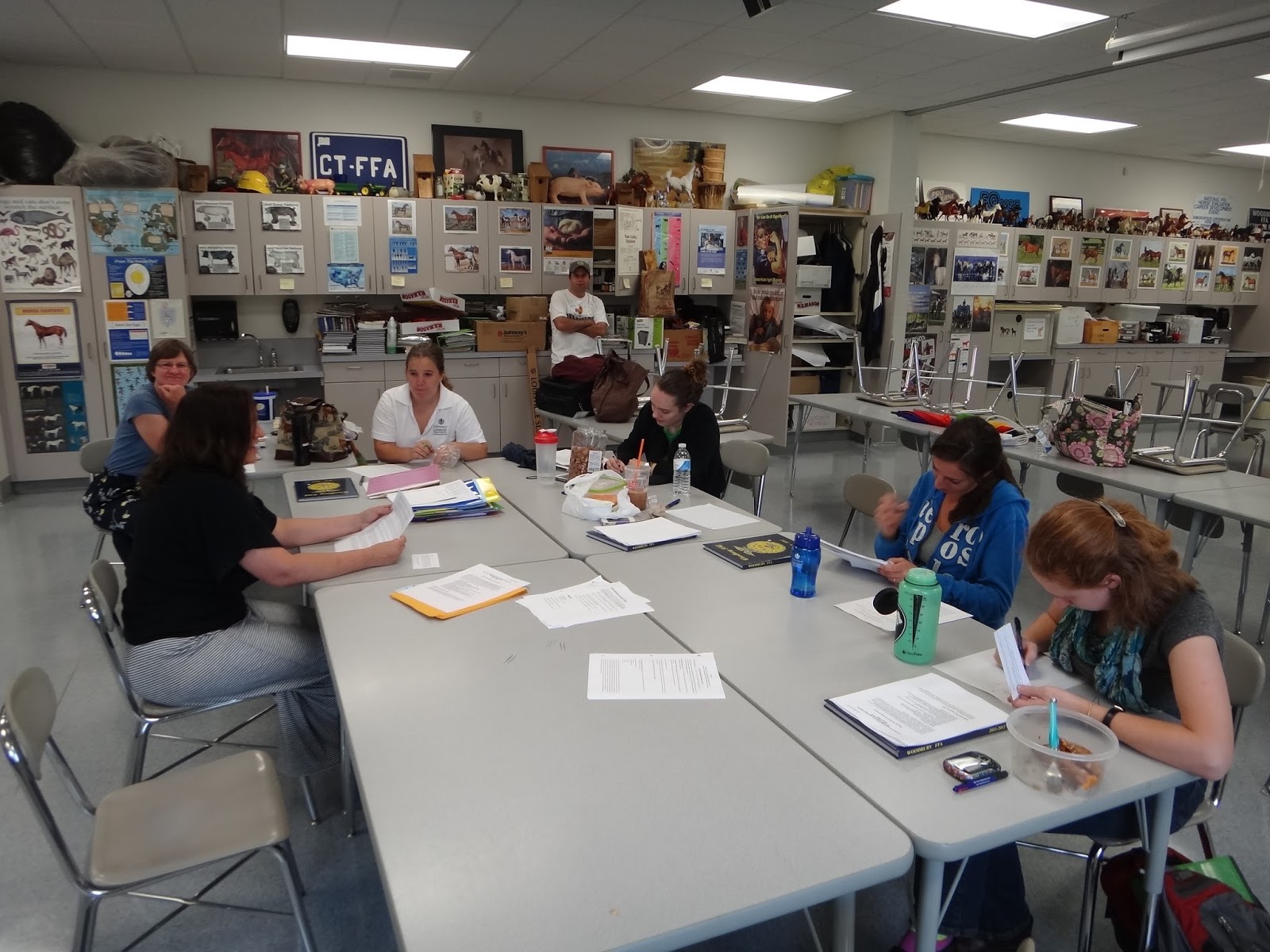
On Tuesday, September 9th, I had the opportunity to present to members of our Woodbury FFA Alumni and Parent Support Group. This organization consists of primarily current student's parents, some of which are graduates of our ag program, as well as recent graduates, and a former ag program director. Also in attendance were a few current students, who attended along with their parents, and my fellow agriscience teaching staff. In total, there were approximately 50 people in attendance.
I modified the previous presentations that I have done for our faculty and staff and UConn student teachers in order to target this particular audience. I tried to focus more on the community based involvement that we witnessed at Suwon, as well as the examples of the recent alumni of their programs coming back to teach students skills in the evening.
Unlike the previous presentations, I did not get a lot of questions. It might have been that it was about 8:20pm when I started to present. One question that did stand out what the following:
Were you able to ask the community members who were volunteering their time at the schools why they chose to spend that time in the school? What benefit did they feel that they were gaining by involving themselves with the education of the students?
I thought this was a great question, but I didn't feel as though I had really asked these community members this question myself. I attributed their desire to be involved with the students as part of jeong, which is the very classic "Korean notion of caring for others and putting others before oneself." You can read more about jeong, here.
Showing posts with label Sarah. Show all posts
Tuesday, September 23, 2014
Wednesday, September 3, 2014
Impact Presentation: Nonnewaug High School Faculty and Staff
Today I presented for about a half hour to the faculty and staff of Nonnewaug High School, which included teachers from all subject areas, Guidance staff, administrators, and Library staff, for a total of approximately 80 people.
I started out by asking the staff what came to mind when they heard the word "Korea." Answers ranged from anything related to K-Pop, to things they had heard in the news regarding North Korea. It was interesting to hear what they had to say, especially since more than one person had confused my trip for having been to Japan. I think it was useful for me to include a picture of the world map to help them orient themselves.
As far as the general theme of the presentation, I tried to focus on not only what we learned specifically about
Agricultural Education, but also about general education in Korea. I also emphasized the mentoring experience that we engaged in. It seemed to tie in particularly well with what we had been discussing in our Professional Learning today, since we were going over the new Teacher Evaluation Rubric from the Connecticut Common Core of Teaching.
One of the areas that we are assessed on is "Professional Responsibilities and Teacher Leadership." In order to demonstrate an exemplary rating, one must "Participate actively in required professional learning and seek out opportunities within and beyond the school to strengthen skills and apply new learning to practice, as well as taking a lead in and/or initiates opportunities for professional learning with colleagues." It seemed that what our practice in Korea was doing, was helping to model a method of Professional Learning that could be implemented in the U.S. as well.
Much of our Professional Learning today was centered on "data-driven decision making", "research" and lots of number crunching. When presented with this information all day, it can be extremely overwhelming and daunting to feel motivated about the craft of teaching. I emphasized the focus that South Korea is placing on "Happy and Creative Education for All" as a way for us to re-center our learning on the art and passion we all have for teaching. I felt that the staff responded in a very positive fashion and they seemed to enjoy the presentation quite a bit!
Questions asked include the following:
1. What do people do for recreation in South Korea?
2. With all of the emphasis on intensive hands-on instruction, how many students go on to pursue a college education in South Korea?
3. What is South Korea's stance towards GMOs? (Genetically Modified Organisms)
4. When you were planning your micro-lessons, did you bear in mind the "Happy and Creative Education for All" as a guiding principle for lesson planning?
I really enjoyed the opportunity to present to my fellow staff members. I had the unique chance to teach fellow teachers about agricultural education through another lens. We have a lot of new staff at our school, so not only did this teach them about Korean Ag Ed, but also Agricultural Education in the US.
While I was answering the 4th question listed above, I had the opportunity to share the "nugget" of information that we formulated while at Yeoju: "Good teaching for English Language Learners or other students with learning needs, is good teaching for all students!" I emphasized the need for planning that doesn't focus exclusively on hands-on activities that are fun just for the sake of making students happy, but also for them to be "hands-on, minds-on." Frequently Agriscience classes may have the misconception that they are just classes for kids to "go play in" without learning any meaning behind the activity they are performing. This discussion was the perfect platform to help dispel that myth.
I started out by asking the staff what came to mind when they heard the word "Korea." Answers ranged from anything related to K-Pop, to things they had heard in the news regarding North Korea. It was interesting to hear what they had to say, especially since more than one person had confused my trip for having been to Japan. I think it was useful for me to include a picture of the world map to help them orient themselves.
One of the areas that we are assessed on is "Professional Responsibilities and Teacher Leadership." In order to demonstrate an exemplary rating, one must "Participate actively in required professional learning and seek out opportunities within and beyond the school to strengthen skills and apply new learning to practice, as well as taking a lead in and/or initiates opportunities for professional learning with colleagues." It seemed that what our practice in Korea was doing, was helping to model a method of Professional Learning that could be implemented in the U.S. as well.
Much of our Professional Learning today was centered on "data-driven decision making", "research" and lots of number crunching. When presented with this information all day, it can be extremely overwhelming and daunting to feel motivated about the craft of teaching. I emphasized the focus that South Korea is placing on "Happy and Creative Education for All" as a way for us to re-center our learning on the art and passion we all have for teaching. I felt that the staff responded in a very positive fashion and they seemed to enjoy the presentation quite a bit!
Questions asked include the following:
1. What do people do for recreation in South Korea?
2. With all of the emphasis on intensive hands-on instruction, how many students go on to pursue a college education in South Korea?
3. What is South Korea's stance towards GMOs? (Genetically Modified Organisms)
4. When you were planning your micro-lessons, did you bear in mind the "Happy and Creative Education for All" as a guiding principle for lesson planning?
I really enjoyed the opportunity to present to my fellow staff members. I had the unique chance to teach fellow teachers about agricultural education through another lens. We have a lot of new staff at our school, so not only did this teach them about Korean Ag Ed, but also Agricultural Education in the US.
While I was answering the 4th question listed above, I had the opportunity to share the "nugget" of information that we formulated while at Yeoju: "Good teaching for English Language Learners or other students with learning needs, is good teaching for all students!" I emphasized the need for planning that doesn't focus exclusively on hands-on activities that are fun just for the sake of making students happy, but also for them to be "hands-on, minds-on." Frequently Agriscience classes may have the misconception that they are just classes for kids to "go play in" without learning any meaning behind the activity they are performing. This discussion was the perfect platform to help dispel that myth.
Thursday, August 7, 2014
Impact: XM Radio Broadcast!
Prior to leaving for our amazing adventure to Korea, I was contacted by a member of the National Association of Farm Broadcasters about doing an interview for their RFD-TV Radio show on FFA Today! I was super excited to talk with her about not only what was going on in the ag program that I teach in, but also to discuss the things we learned in Korea. I mentioned this to her, since initially, she wanted to interview me during the time frame in which I would be gone, but she was fortunately very flexible with the interview times and gladly offered to interview me upon my return to the U.S. Turns out, that she had already heard of the trip! Very cool.
I was asked a few questions including the following:
1. How long have you been involved with FFA and why did you become an FFA Advisor?
2. Your chapter now raises vegetables for the school cafeteria and the local food pantry. Tell us about this and how it has impacted your students.
3. You also traveled to South Korea in July to work with the Future Farmers of Korea. What did you do on this trip?
4. So why do you think FFA is an important and relevant organization for students today to be a part of?
If you'd like to listen to the interview, check it out here! It originally aired on Saturday, July 26th, and Sunday, July 27th.
I feel like I tried to cram a lot of information into each answer, so perhaps some of the responses came off a bit rambling, but I really enjoyed the opportunity to reach more people with the message of FFA and #AgEd2Korea!
I was asked a few questions including the following:
1. How long have you been involved with FFA and why did you become an FFA Advisor?
2. Your chapter now raises vegetables for the school cafeteria and the local food pantry. Tell us about this and how it has impacted your students.
3. You also traveled to South Korea in July to work with the Future Farmers of Korea. What did you do on this trip?
4. So why do you think FFA is an important and relevant organization for students today to be a part of?
If you'd like to listen to the interview, check it out here! It originally aired on Saturday, July 26th, and Sunday, July 27th.
I feel like I tried to cram a lot of information into each answer, so perhaps some of the responses came off a bit rambling, but I really enjoyed the opportunity to reach more people with the message of FFA and #AgEd2Korea!
Friday, July 18, 2014
Impact on University of Connecticut Agricultural Education
Yesterday, I hosted the Methods of Teaching Agricultural Education class from the University of Connecticut, at my school. This year, there are 5 students in the one-year certification program class, and their Professor, Dr. Patricia Jepson, holds class at a different ag center each week. They have class once a week for 6 hours, and while they are at each center, they meet with some of the ag teachers there, and tour the facilities. Because the certification program has several different campuses at which the classes are taught, this was the first time that all five Ag Ed candidates were meeting all together. They started out their day by introducing themselves and their background regarding Ag Ed. Some had been through School Based Ag Education (SBAE) and others hadn't. I spent a majority of my time giving them a tour of our facilities and then spent about half an hour talking about my experiences in Korea.
Prior to their visit, I sent them the blog link and twitter feed info, and some of them did indeed read it! During my presentation about Korea to them, I had them engage in the "Simulated Confusion" activity that Cassidy designed for our reflection. It worked pretty well for the intended purpose of creating confusion with both the "students" and the "teacher," though I had to step in and model some of the communication behavior between "students." After this activity, we had a conversation about why this activity was done- to simulate the feeling of confusion that some of our students may have in our classes, especially if they are English Language Learners or students with a learning disability. I think the activity hit home for these teacher candidates.
After that activity, I posed the question, "What does it mean to be globally competent?". It was clear that this was something that the teacher candidates hadn't considered much about before, so we broke it down into smaller chunks. In preparation for my presentation, I did some research and found a great resource for teaching global competency. According to the Global Competence Matrix, global competence is defined as "the capacity and disposition to understand and act on issues of global significance." Once I read that off to them, we brainstormed different skills that would be necessary to accomplish that goal of being globally competent. The Global Competence Matrix identifies 4 major skills or ways that students demonstrate global competence:
1. Students investigate the world beyond their immediate environment.
2. Students recognize their own and others perspectives.
3. Students communicate their ideas effectively with diverse audiences.
4. Students translate their ideas and findings into appropriate actions to improve conditions.
I gave them some resources from the Global Competence Matrix, including some ideas for how you can implement these skills into your classroom.
We also discussed one of the ideas that we reflected on while in Korea:
"Teaching that works well for English Language Learners is good teaching for everyone!"
I wrapped up my presentation with them by going through a Power Point that I put together highlighting Korean SBAE and the 4 high schools that we visited. It was very difficult to sift through the some 2,000 photos I took and put only a few key photos in the presentation!
I think these teacher candidates might benefit from more guided instruction regarding the impact points we brought back with us from our trip, but at a later date. Right now they are still trying to wrap their head around U.S. SBAE. Great first presentation!
Prior to their visit, I sent them the blog link and twitter feed info, and some of them did indeed read it! During my presentation about Korea to them, I had them engage in the "Simulated Confusion" activity that Cassidy designed for our reflection. It worked pretty well for the intended purpose of creating confusion with both the "students" and the "teacher," though I had to step in and model some of the communication behavior between "students." After this activity, we had a conversation about why this activity was done- to simulate the feeling of confusion that some of our students may have in our classes, especially if they are English Language Learners or students with a learning disability. I think the activity hit home for these teacher candidates.
| UConn Ag Ed Master's Students participating in the "Confusion" activity. |
After that activity, I posed the question, "What does it mean to be globally competent?". It was clear that this was something that the teacher candidates hadn't considered much about before, so we broke it down into smaller chunks. In preparation for my presentation, I did some research and found a great resource for teaching global competency. According to the Global Competence Matrix, global competence is defined as "the capacity and disposition to understand and act on issues of global significance." Once I read that off to them, we brainstormed different skills that would be necessary to accomplish that goal of being globally competent. The Global Competence Matrix identifies 4 major skills or ways that students demonstrate global competence:
1. Students investigate the world beyond their immediate environment.
2. Students recognize their own and others perspectives.
3. Students communicate their ideas effectively with diverse audiences.
4. Students translate their ideas and findings into appropriate actions to improve conditions.
I gave them some resources from the Global Competence Matrix, including some ideas for how you can implement these skills into your classroom.
We also discussed one of the ideas that we reflected on while in Korea:
"Teaching that works well for English Language Learners is good teaching for everyone!"
I wrapped up my presentation with them by going through a Power Point that I put together highlighting Korean SBAE and the 4 high schools that we visited. It was very difficult to sift through the some 2,000 photos I took and put only a few key photos in the presentation!
I think these teacher candidates might benefit from more guided instruction regarding the impact points we brought back with us from our trip, but at a later date. Right now they are still trying to wrap their head around U.S. SBAE. Great first presentation!
Thursday, July 10, 2014
What was the food like in Korea?
As our departure from Korea quickly approaches, we will be posting
thoughts and stories from #AgEd2Korea participants to reflect on the
breadth, depth and diversity of our experiences here in Korea. This
blog showcases some of the answers to the question, "What was the food like in Korea?"
"Well, I love surprises, so I guess you can say I love Korean food.
It wasn’t always clear what we were eating at meal time but I enjoyed
it (for the most part…)! It also encouraged me to try new foods, whether
it was intentional or not. "
– Janae
"I liked that there were many side dishes that were shared as a group. I think it plays back into the cultural mindset of group collaberation. We all shared these dishes and it was just another way for us to emerge ourselves into their culture."
– Deanna
"It’s different. Good luck finding half of this stuff in restaurants back home. Now, I’ll be the first to tell you that I’m a meats and potatoes kind of guy, but, it was great to be in a place where the food was unique, just like the experiences. I remember how excited I got when I saw a street vendor selling silk worm larvae, or when I tried cold noodles for the first time." – Howard
"I liked the bibimbop the best because there were many different combinations that you could choose from and it was a complete meal that filled you up. "
– Jason
"Variety and spicy is the Korean food cuisine. My favorite dish was the bulgoli because it was not spicy, but had a great flavor. I did enjoy eating more vegetables and fruit and less dairy products and carbs. I felt like I had more energy." - Jess
"I think what I liked best about Korean food was how we weren’t quite sure what we were going to be served at each meal…it was sort of a guessing game as to what dishes you would see on the table."
- Sarah
"The number of dishes and side dishes that are served with any meal is perhaps the most enjoyable part of Korean food. Through the variety of entrees, soups, salads, and sides served, sometimes up to 30, I was able to try different combinations of flavors that enhanced the sensory experience through taste, texture, sight, and smell!" - David
– Janae
"I liked that there were many side dishes that were shared as a group. I think it plays back into the cultural mindset of group collaberation. We all shared these dishes and it was just another way for us to emerge ourselves into their culture."
"It’s different. Good luck finding half of this stuff in restaurants back home. Now, I’ll be the first to tell you that I’m a meats and potatoes kind of guy, but, it was great to be in a place where the food was unique, just like the experiences. I remember how excited I got when I saw a street vendor selling silk worm larvae, or when I tried cold noodles for the first time." – Howard
"I liked the bibimbop the best because there were many different combinations that you could choose from and it was a complete meal that filled you up. "
– Jason
"Variety and spicy is the Korean food cuisine. My favorite dish was the bulgoli because it was not spicy, but had a great flavor. I did enjoy eating more vegetables and fruit and less dairy products and carbs. I felt like I had more energy." - Jess
"I think what I liked best about Korean food was how we weren’t quite sure what we were going to be served at each meal…it was sort of a guessing game as to what dishes you would see on the table."
- Sarah
"The number of dishes and side dishes that are served with any meal is perhaps the most enjoyable part of Korean food. Through the variety of entrees, soups, salads, and sides served, sometimes up to 30, I was able to try different combinations of flavors that enhanced the sensory experience through taste, texture, sight, and smell!" - David
Labels:
David,
Deanna,
food adventures,
Howard,
Janae,
Jason,
Jess,
Korean Food,
Sarah
What surprised you the most about Korea?
As our departure from Korea quickly approaches, we will be posting thoughts and stories from #AgEd2Korea participants to reflect on the breadth, depth and diversity of our experiences here in Korea. This blog showcases some of the answers to the question, "What surprised you the most about Korea?"
"I was most surprised by the hospitality that I encountered while in country. I can honestly say that I did not have one bad experience while interacting with people. Whether it was while I was shopping, touring, or in the classroom. People were truly excited to meet with us and help us as needed."
- Deanna
"As we toured the countryside and looked at farms at the different high schools, I was surprised by the amount of technology that these farms used. I came in expecting a few pastures with some old cows and goats. But I was blown away by the amount of technology; between the universal use of greenhouses, to seeing a compost aerator, and a robotic milker. It never stopped amazing me how smoothly technology was integrated into agriculture."
– Howard
"What surprised me the most was how quickly the time seemed to pass by. Today is our very last day in Korea and they say we have been here for a month, but I swear we just arrived yesterday. Each day was filled to the brim with either educational or cultural activities. Even our 'days off' were jammed packed because there was so much to see and do! What I have learned from this though is that every minute you are abroad counts for something. There is always something to be taken from each moment you have."
– Janae
"I think what surprised me the most was how innovative Korean agriculture is. I was not expecting to see the intensive use of the acreage that we saw while traveling through the Korean countryside. They have extremely intensive production and seem to have a keen awareness of the need for sustainable practices in their country. I was also very impressed at the level of technology and depth of industry education available to high school students!"
– Sarah
| One of the many gourmet meals provided by our gracious hosts |
- Deanna
"As we toured the countryside and looked at farms at the different high schools, I was surprised by the amount of technology that these farms used. I came in expecting a few pastures with some old cows and goats. But I was blown away by the amount of technology; between the universal use of greenhouses, to seeing a compost aerator, and a robotic milker. It never stopped amazing me how smoothly technology was integrated into agriculture."
| Greenhouse at Yeoju Self-Management High School |
"What surprised me the most was how quickly the time seemed to pass by. Today is our very last day in Korea and they say we have been here for a month, but I swear we just arrived yesterday. Each day was filled to the brim with either educational or cultural activities. Even our 'days off' were jammed packed because there was so much to see and do! What I have learned from this though is that every minute you are abroad counts for something. There is always something to be taken from each moment you have."
– Janae
"I think what surprised me the most was how innovative Korean agriculture is. I was not expecting to see the intensive use of the acreage that we saw while traveling through the Korean countryside. They have extremely intensive production and seem to have a keen awareness of the need for sustainable practices in their country. I was also very impressed at the level of technology and depth of industry education available to high school students!"
– Sarah
Sunday, July 6, 2014
Only Human...
During this trip we have gotten to do a lot of really cool things to learn about not only Korean Agriculture Education, but also Korea's cultural heritage. We have traveled to cities and countryside, by trains, planes, and buses. We have met students of all ages; elementary, high school, and college. We have toured government agencies, cultural landmarks, schools, villages, cities, forests, and farms. It has been a completely AWESOME experience!
Throughout this trip, we have focused a lot on learning how Korea does the business of agriculture education. I think in my own mind, I have come to this learning experience from the vantage point that I was going to be seeing things that were very different from what we know at home, not only with Ag Ed, but culturally as well. It is very easy to focus on all the things that are different from our own experiences. There's a few things that are different here than home, that I've found it a little challenging to adjust to:
-Napkins that are the size of what we would call "cocktail napkins" as your only napkin during a meal, if any. I am used to having one that folds out and is placed in my lap, so eating without getting food on myself has been a real challenge!
-Very small cups of water with a meal, but usually only consumed at the end of a meal. I like to drink water throughout a meal, especially when the meal is spicy, but this is considered "bad for digestion" in Korea.
-Minimal trash cans. There are hardly any of these in this country! The streets are usually very clean, so I am not quite sure where people throw away their trash, but there isn't a lot to be seen. Just tonight, we had ice cream in a Baskin Robbins (yes like the chain from the US), and when we went to throw away our cups, there were absolutely no trash cans in sight...turns out the staff behind the counter will gladly take them off your hands.
There are tons of other things we could go on to list that are different between Korea and the United States, but what I've come to see increasingly clearly, are the things that are the same between our two cultures.
Both Korean and American college students preparing to be teachers share similar reasons for why they wanted to be a teacher:
-"I've known since I was 6 years old that I wanted to be a teacher. This is my dream!"
-"I had a great homeroom teacher in 6th grade that was my favorite teacher of all time. I want to be a teacher because of him. I hope I can be that kind of teacher too."
-"I had a wonderful experience through my agriculture education program in high school, and I wanted to provide the same opportunity for other students."
-"I had the opportunity to help teach a class, and I loved it! That inspired me to become a teacher."
Looking at the responses above, I'll be you couldn't identify which statements were from Korean students and which are from American students!
Korean Ag Education Graduate Students. The student closest to me wants to be a landscaping teacher!
It's not only the outlook on education, but who we are as people. Walking around the streets of Seoul, you will see A LOT of people. You become very aware that you don't look like most of these people if you are not of Asian descent. But as you peer a little closer, you start to notice the similarities:
-Old and young couples hand in hand, many times wearing coordinating outfits.
-Young children squealing in delight over playing in the water fountain.
-Parents scurrying after their child who just escaped their grasp.
-Groups of old women cackling together.
-Friendly Samaritans, who stop to help us find our way in the subway system.
-Giggling adolescent girls, just getting their first taste of independence and "fashionable" clothing, makeup, and perfume.
-Happy, content children, eager to see their teachers or principals.
-The high school cliques: jocks, nerds, quiet kids, popular girls..the list goes on.
Families walking along the street in Insa-Dong
I could keep listing these things but this blog post would keep on going!
Today I had the opportunity to share a delicious meal with Robin, one of the teachers we met at Suwon, and Kelli. Robin brought her 2 year old daughter along with her, and the four of us had a lovely lunch together. We come from very different parts of the globe, but ultimately we all came together and spent time together, not necessarily to learn more about the other's culture, but to share each other's company as people.
Because really, despite the differences in culture, history, food, location on the globe, we really are all people. We are all connected as members of the human race, and even though we are halfway around the world from each other, we really aren't all that far away. We all share this Earth together and want to see our families and friends learn, grow, and love.
There are lots of barriers to international relations between countries. I think the first step in getting over our differences is to realize that we are all in this together. As humans. On this one place we call home, Earth.
Thursday, July 3, 2014
Future Farmers of Korea!
Prior to this trip, I had never heard of the FFK (Future Farmers of Korea). I consider myself to be an all out FFA nerd, and was extremely excited to hear that we would be meeting with representatives of the FFK!
I had the fortunate opportunity to meet with FFJ (Future Farmers of Japan) students while at National FFA Convention this past fall, and it totally made my student's day. They didn't realize that the FFJ existed, and were elated to hear that other countries around the world had an organization similar to ours.
When I was in FFA in high school, I had heard of a Future Farmer Organization in Bosnia and read about the FFJ in the New Horizons Magazine, but never of any others.
I had the fortunate opportunity to meet with FFJ (Future Farmers of Japan) students while at National FFA Convention this past fall, and it totally made my student's day. They didn't realize that the FFJ existed, and were elated to hear that other countries around the world had an organization similar to ours.
When I was in FFA in high school, I had heard of a Future Farmer Organization in Bosnia and read about the FFJ in the New Horizons Magazine, but never of any others.
My students at National FFA Convention 2013, ELATED to meet the FFJ!!
So, when our group traveled to Korea, I was eagerly awaiting the opportunity to meet with the FFK. This past Friday, we finally got to learn about FFK! During our lesson presentation earlier in the week we talked to students about FFK, and it turned out that the Suwon FFK Chapter President was in our class, which was really cool. I thought that since school was currently in session that we would have a presentation on FFK from student members, but it ended up that teachers and FFK staff presented to us instead. We got to watch a presentation about the basics of FFK, and also ask questions about it at the end. Here's some of the highlights of the presentation:
-All agriscience students can be members of the FFK, pending that they pay their annual dues of 3,500 Won (about $3.50).
-Upon paying membership dues, students receive their membership pin and a newsletter.
-Students can participate in regional and national skill competitions. These include baking, landscape design work, and floral arranging, among many others.
-There are 71 schools that offer FFK as an option for students to be involved in. These 71 schools are grouped into "chapters", with 14 chapters total. In the FFA, a chapter is located at the local level, with each high school or middle school having their own chapter. When we asked for clarification of the 14 chapters, it sounded as though they were regional groupings, like our FFA state associations. These chapters are formed based on membership, so some chapters are located around cities and only include students from that area since there is a more dense population, while others are entire provinces.
-The country is divided into 4 FFK regions, modeled after the FFA regions: Western, Central, Southern, and Eastern. A National Officer Team exists, and is comprised of a National President, and 4 Regional Vice Presidents, one for each region. Th National President can only be elected from the previous year's Regional Vice Presidents. This year's National FFK President is only a Junior in high school!
-The National FFK Convention rotates its location each year, with various high schools around the country hosting it each year. Suwon High School for Agricultural Sciences will be hosting it this coming September.
-The National Convention attracts about 1,000 students and has 2 major parts:
1. Skill competitions & Election of Officer
2. Entertainment
We got to see a highlights video of their National Convention and these students really get into the fun they have! We saw a wide variety of talent displayed, and part of one of the most popular contests, the Golden Bell. This is basically a survival quiz about various agricultural knowledge and students compete individually, writing their answers on a hand held white board. If they get a question wrong, they are knocked out and the last student standing wins.
-There is no official dress, but at National FFK Convention, students wear polo shirts representing their chapter or school.
We were all given our very own FFK membership pins!!
I was also really interested in learning about the FFK emblem. Our FFA emblem is steeped in tradition and symbolism so I was curious to see if the FFK was the same. It seems there is some symbolism, but som of it is unclear. The 2 dots at the top of the emblem represent the eyes of leadership and the flower-like design below the dots represent the creative energy of the youth. From what I could gather, their colors were green and gold.
Clearly, I am stoked to be learning about the FFK!
We asked our presenters what they felt the biggest challenge for FFK was. We found that they battle similar stereotypes that we sometimes do in the US, regarding the image of an agricultural life and career. Many students in Korea don't necessarily find agriculture an appealing industry to work in because they don't think it has prestige and is a lot of hard work. FFK is working to change that by offering a more diverse array of activities to help develop leadership. I'd say that we as FFA members and advisors, we also are continuously presenting ourselves in a variety of formats to reach a more diverse array of students. I was impressed to hear that the FFK boasts a national membership of 22,994 members! Along with all of the leadership opportunities and skill development events, FFK members are also given the opportunity to work with a mentor farmer, ones that are considered innovative. What a great way to involve the industry by pushing your bright stars into the careful guidance of those who are currently leading the way in agriculture!
I think it would be so cool to have a partnership with FFK and FFA. I also learned that there is a Future Farmers of Thailand too! Think of all the opportunity that our students could have by developing a cooperative relationship with these other parallel student organizations.
If you would like to learn more about the FFK, check out their website. I especially like their Creed, which is very similar to the FFA Creed. Check it out!
Friday, June 27, 2014
Global Teaching in Action
What a great week! All groups of students and their accompanying teachers were able to present their lessons to Korean high school students at Suwon High School for Agricultural Sciences, not just once, but twice.
The opportunity to revisit the lesson after the first day of teaching proved invaluable to student and teacher success. Through this experience we were able to modify our lesson as needed, once we became more familiar with the needs and abilities of our students.
Most of the teachers and students from our group were under the impression that our Suwon students would be somewhat proficient in English, with about half of our class able to potentially interact with us in English. That proved to not be the case, as only about 3 students in our classes were able to speak with us in English. It seems more were able to read it, but didn't feel comfortable conversing in it. This meant that we depended heavily on our Seoul National University students to help us translate key directions if students did not understand, or to translate student responses. Big thank yous go out to all of our SNU teaching partners!
In order to work through language barriers, our teaching groups came up with some strategies:
1.Utilize pictures or diagrams whenever possible.
2. Our SNU partners translated much of our PowerPoint and worksheet into Korean, in addition to our verbal directions.
3. Speaking slowly and clearly, while also allowing wait time to allow students to collect their thoughts and process what we said.
4. Show students you care. Most, if not all of our teaching teams introduced themselves in Korean, which was a BIG hit!
5. Enthusiasm and a positive attitude along with patience. These expressions of joy in what you do transcends all language.
6. Allow students time to work together in small groups to process the information together.
Many of our AgEd2Korea participants tweeted specific suggestions that worked well for them on our #AgEd2Korea feed after reflecting on their lessons. Check it out!
Today we were able to follow up with some of the teachers of the classes we took over yesterday. They said that their students absolutely loved having us come into their school and teach. They had tons of fun and enjoyed learning about agriculture from us.
One teacher I spoke with teaches English at Suwon, and it was her class that Rachel, TaeHeon, and I taught yesterday. She said that the students have shown a renewed interest and drive to learn English after interacting with us yesterday. They were so excited to talk about class and what they learned! She asked if they would be interested in visiting the United States one day and they were very enthusiastic about the idea. Wouldn't that be cool? Having an international exchange with FFA and FFK students would be so neat!
Thursday, June 19, 2014
Lesson Planning Across the Globe
Annyeohaseo! What a whirlwind the past few days have been. Seoul is a beautiful city, with the skyline interspersed with glimpses of the heavily forested mountains. Although we have gotten the opportunity to explore the city in the afternoon, our days have been spent primarily working on two things: Korean language school, and lesson planning.
This is the view out of the back balcony from the SNU CALS building. Mountains everywhere!
Part of what we are doing while we are in Korea is visiting Korean agricultural high schools, where we will not only get to observe teaching and learning in the high school, but also have the opportunity to design and deliver a lesson to Korean agriculture students! All of the current ag educators from the US have been paired up with current Penn State students, as well as a current Seoul National University (SNU) student to design and deliver an ag-related lesson of their choice.
I have been paired up with Rachel from Penn State, and TaeHeon Song of SNU. Over the past few days we have been working together to create our lesson and materials. Having TaeHeon along with us has been invaluable since he is able to provide us with a Korean perspective as well as be able to converse with us in English! It continually amazes me how proficient in English most people we have met seem to be. I am extremely grateful for the dual signage and the hospitality that all Koreans have shown us since we have arrived!
Some of the topics that our teams have chosen to present lessons on topics such as animal byproducts, asexual propagation of plants, animal disease control, and global ag technologies. Rachel, TaeHeon and myself have chosen to present a lesson on sustainability of food production. Our interest based approach is through kimchi. Kimchi is a fermented food very popular in Korea, so popular that it is eaten at pretty much every meal, including breakfast. It is usually made of cabbage and a red pepper powder (gochu garu). We want our students to think about eating seasonally and more locally as a way to be more sustainable. We are going to have our students make a list of the ingredients in one type of kimchi (there are literally hundreds of types) that we have them sample, and then try to identify the location of where that ingredient was grown or harvested. Similar lessons have been presented to American students but using the cheeseburger or pizza as an example instead of kimchi.
Rachel and TaeHeon hard at work editing our presentation on Kimchi and Sustainability.
While working on creating our materials for our lesson today, we had the opportunity to work in the computer lab at the College of Agriculture and Life Sciences (CALS). This proved extremely challenging as all of the text on the screen was in Hangeul (Korean characters). The keyboard was in both Hangeul and English, and we were fortunately able to change the characters being typed on the screen from Hangeul to English. I created a handout for our Korean students in English, and then TaeHeon went back and typed subtitles in Korean to make it easier for our students to understand.
This is the view out of the back balcony from the SNU CALS building. Mountains everywhere!
Part of what we are doing while we are in Korea is visiting Korean agricultural high schools, where we will not only get to observe teaching and learning in the high school, but also have the opportunity to design and deliver a lesson to Korean agriculture students! All of the current ag educators from the US have been paired up with current Penn State students, as well as a current Seoul National University (SNU) student to design and deliver an ag-related lesson of their choice.
I have been paired up with Rachel from Penn State, and TaeHeon Song of SNU. Over the past few days we have been working together to create our lesson and materials. Having TaeHeon along with us has been invaluable since he is able to provide us with a Korean perspective as well as be able to converse with us in English! It continually amazes me how proficient in English most people we have met seem to be. I am extremely grateful for the dual signage and the hospitality that all Koreans have shown us since we have arrived!
Dual language signage in the SNU CALS Building.
Some of the topics that our teams have chosen to present lessons on topics such as animal byproducts, asexual propagation of plants, animal disease control, and global ag technologies. Rachel, TaeHeon and myself have chosen to present a lesson on sustainability of food production. Our interest based approach is through kimchi. Kimchi is a fermented food very popular in Korea, so popular that it is eaten at pretty much every meal, including breakfast. It is usually made of cabbage and a red pepper powder (gochu garu). We want our students to think about eating seasonally and more locally as a way to be more sustainable. We are going to have our students make a list of the ingredients in one type of kimchi (there are literally hundreds of types) that we have them sample, and then try to identify the location of where that ingredient was grown or harvested. Similar lessons have been presented to American students but using the cheeseburger or pizza as an example instead of kimchi.
Rachel and TaeHeon hard at work editing our presentation on Kimchi and Sustainability.
While working on creating our materials for our lesson today, we had the opportunity to work in the computer lab at the College of Agriculture and Life Sciences (CALS). This proved extremely challenging as all of the text on the screen was in Hangeul (Korean characters). The keyboard was in both Hangeul and English, and we were fortunately able to change the characters being typed on the screen from Hangeul to English. I created a handout for our Korean students in English, and then TaeHeon went back and typed subtitles in Korean to make it easier for our students to understand.
Normally, making a handout only takes me about 10-15 minutes to put together, but the combination of the language barrier and a computer that didn't want to cooperate with me, made for a very long and frustrating session. However, we were successful. I am very much looking forward to working with Rachel and TaeHeon to present our lesson!
Check back next week to see how our lesson went with our Korean students!
Tuesday, April 8, 2014
Tigers, Rabbits, and Magpies...oh my! Sarah's Art Adventure
Recently, we all completed an assignment where we all had the option to research a topic of our choice regarding Korea. I wanted to make this a meaningful experience for myself, so I settled upon researching the presence of the Tiger in Korean artwork. I have a degree in animal science, and I've always really enjoyed learning about wildlife, so when I first learned of the significance of the Tiger to the Korean people, I was very intrigued. The Tiger appears in Creation stories in Korea, and continues to be a symbol of national pride. In addition to the myriad of ag-related interests I have, I also really enjoy creating artwork. I draw, paint, needle felt, and generally enjoy creating any kind of art. I decided to explore the meaning of the Tiger through my own artwork and decided that I would compile a variety of examples of Korean Artwork depicting the Tiger, which I would then use to guide the creation of my own representation of the Korean Tiger.
Here are a few examples of the artwork I found:
I decided to put two Tigers in this painting to represent both parts of the Korean Peninsula: The People's Republic of Korea (South Korea) and the Democratic People's Republic of Korea (North Korea). Korea is known as the "Land of the Tiger" regardless if it is the North or South part you are referring to. Ironically, the Tiger is extinct in both countries, but a very small chance exists that the Tiger might be living in the DMZ. The Tigers are engaged in a snarl/roar, but are tolerating each others' presence, in order to suggest the current armistice between the two nations. Between the two Tigers is a Magpie, calling upon the ancient meaning of good news. Hopefully, the two countries can come to an amicable agreement, and the Magpie was put between the two Tigers to suggest that there could be a better relationship between the two. The background of red and blue hearkens to the Yin Yang on the South Korean flag, representing a balance of the forces in the universe. Harmony is the ultimate goal in balance, and hopefully the two Koreas can come to live in harmony with one another. Finally, I chose to paint this subject in watercolor, as many of the minhwa in my research were pen and ink with watercolor.
I hope you all have enjoyed my painting and learning a little bit more about Korean art! I'd be interested to hear of any other interpretations people might have about the Tiger in Korean art and culture.
Here are a few examples of the artwork I found:
Above photo from Korea Times
Jar from the Collections of the Asian Art Museum
Modern White Tiger, 2010. Visit Korea
Over the course of my research, I found that in addition to the Tiger, the Magpie was repeatedly appearing alongside the Tiger. Upon further investigation, I discovered the the Magpie was viewed as the bearer of good news, and the Tiger represented a variety of things, including good luck, courage, pride, and being a guardian or ward against evil spirits. If you do a quick Google search of the Tiger and Magpie, you'll find a variety of "minhwa" or Korean folk paintings that depict the two creatures side by side. You'll also see that the Tiger is frequently depicted smoking a long pipe:
Apparently, instead of starting out fairy tales or folk lore with the phase, "Once Upon a Time...", Korean Folk lore starts with the words, "A Long time ago, when Tigers smoked long pipes...". I thought that was really neat! According to my research, this depiction of the fierce tiger with a comical expression and smoking a pipe, was classic Korean satire.
You might also see the Tiger depicted with Rabbits:
Often the Rabbit appears as well, as the Tiger, Rabbit, and Magpie appear side by side in Korean Folklore, with the Rabbit outsmarting the Tiger.
So, utilizing my research, I decided to create my own painting of the Korean Tiger! See below:
I decided to put two Tigers in this painting to represent both parts of the Korean Peninsula: The People's Republic of Korea (South Korea) and the Democratic People's Republic of Korea (North Korea). Korea is known as the "Land of the Tiger" regardless if it is the North or South part you are referring to. Ironically, the Tiger is extinct in both countries, but a very small chance exists that the Tiger might be living in the DMZ. The Tigers are engaged in a snarl/roar, but are tolerating each others' presence, in order to suggest the current armistice between the two nations. Between the two Tigers is a Magpie, calling upon the ancient meaning of good news. Hopefully, the two countries can come to an amicable agreement, and the Magpie was put between the two Tigers to suggest that there could be a better relationship between the two. The background of red and blue hearkens to the Yin Yang on the South Korean flag, representing a balance of the forces in the universe. Harmony is the ultimate goal in balance, and hopefully the two Koreas can come to live in harmony with one another. Finally, I chose to paint this subject in watercolor, as many of the minhwa in my research were pen and ink with watercolor.
I hope you all have enjoyed my painting and learning a little bit more about Korean art! I'd be interested to hear of any other interpretations people might have about the Tiger in Korean art and culture.
Monday, March 31, 2014
Learning more about Korea: Sarah
Good Morning from Connecticut!
Mother Nature has seen fit to give us another round of winter weather before March is over, so not only did March come in like a lion, it is also going out like one too. I can't believe we are only about 3 months away from our trip to Korea! I am very excited to go and experience a completely different country on the opposite side of the world. Since we are going to be headed to Seoul National University for part of our trip, I decided to look into learning more about SNU.
I was surprised to see when I looked up with course work available at SNU, that the College of Agriculture and Life Sciences was a totally separate college from the College of Veterinary Medicine. The College of Veterinary Medicine appears to absorb undergraduates majoring in Pre-Veterinary Medicine as part of their student body, instead of being an exclusive Graduate Program.
I took a look at the course catalog for the College of Ag and it was interesting to see the variety of courses offered, including one on Medicinal Plants. It also appears that depending on what college you attend, your tuition varies. Compared to the US, where no matter the major, you pay the same tuition, I thought this was unique, but also made sense based on materials fees and the cost of running certain programs.
In the spirit of NCAA March Madness (Go UConn Huskies!!!), I was curious to see if SNU had any symbols or sports. It seems that their school bird is the crane, as they embody longevity, and the ability to experience peace, even when surrounded by turmoil. Interestingly enough, the Crane has done very well in the DMZ, even flourishing! Smithsonian Magazine recently covered an article on the crane in the DMZ: Smithsonian Article on the Crane
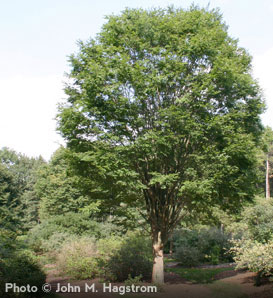
In addition to the crane, the school also has a school tree, the Zelkova Tree. According to the SNU website, "Zelkova trees have strong immunity against diseases and have clean leaves and stems that were considered to represent scholarly qualities in the past. The longevous and generous characteristics of zelkova trees resemble Seoul National University’s fundamental beliefs: the determination to embrace the entire world’s wisdom as an academic leader and to carry on this determination forever. The school respects the sublime values of a scholar akin to the solid and bold branches of the tree and is prepared to embrace ideas of the world like the wide canopy of the zelkova tree’s branches."
Here's a link to the SNU page on their symbols and what they mean.
Enjoy!
Mother Nature has seen fit to give us another round of winter weather before March is over, so not only did March come in like a lion, it is also going out like one too. I can't believe we are only about 3 months away from our trip to Korea! I am very excited to go and experience a completely different country on the opposite side of the world. Since we are going to be headed to Seoul National University for part of our trip, I decided to look into learning more about SNU.
I was surprised to see when I looked up with course work available at SNU, that the College of Agriculture and Life Sciences was a totally separate college from the College of Veterinary Medicine. The College of Veterinary Medicine appears to absorb undergraduates majoring in Pre-Veterinary Medicine as part of their student body, instead of being an exclusive Graduate Program.
I took a look at the course catalog for the College of Ag and it was interesting to see the variety of courses offered, including one on Medicinal Plants. It also appears that depending on what college you attend, your tuition varies. Compared to the US, where no matter the major, you pay the same tuition, I thought this was unique, but also made sense based on materials fees and the cost of running certain programs.
In the spirit of NCAA March Madness (Go UConn Huskies!!!), I was curious to see if SNU had any symbols or sports. It seems that their school bird is the crane, as they embody longevity, and the ability to experience peace, even when surrounded by turmoil. Interestingly enough, the Crane has done very well in the DMZ, even flourishing! Smithsonian Magazine recently covered an article on the crane in the DMZ: Smithsonian Article on the Crane
In addition to the crane, the school also has a school tree, the Zelkova Tree. According to the SNU website, "Zelkova trees have strong immunity against diseases and have clean leaves and stems that were considered to represent scholarly qualities in the past. The longevous and generous characteristics of zelkova trees resemble Seoul National University’s fundamental beliefs: the determination to embrace the entire world’s wisdom as an academic leader and to carry on this determination forever. The school respects the sublime values of a scholar akin to the solid and bold branches of the tree and is prepared to embrace ideas of the world like the wide canopy of the zelkova tree’s branches."
Here's a link to the SNU page on their symbols and what they mean.
Enjoy!
Subscribe to:
Posts (Atom)