Saturday, July 12, 2014

Meaningful Interactions


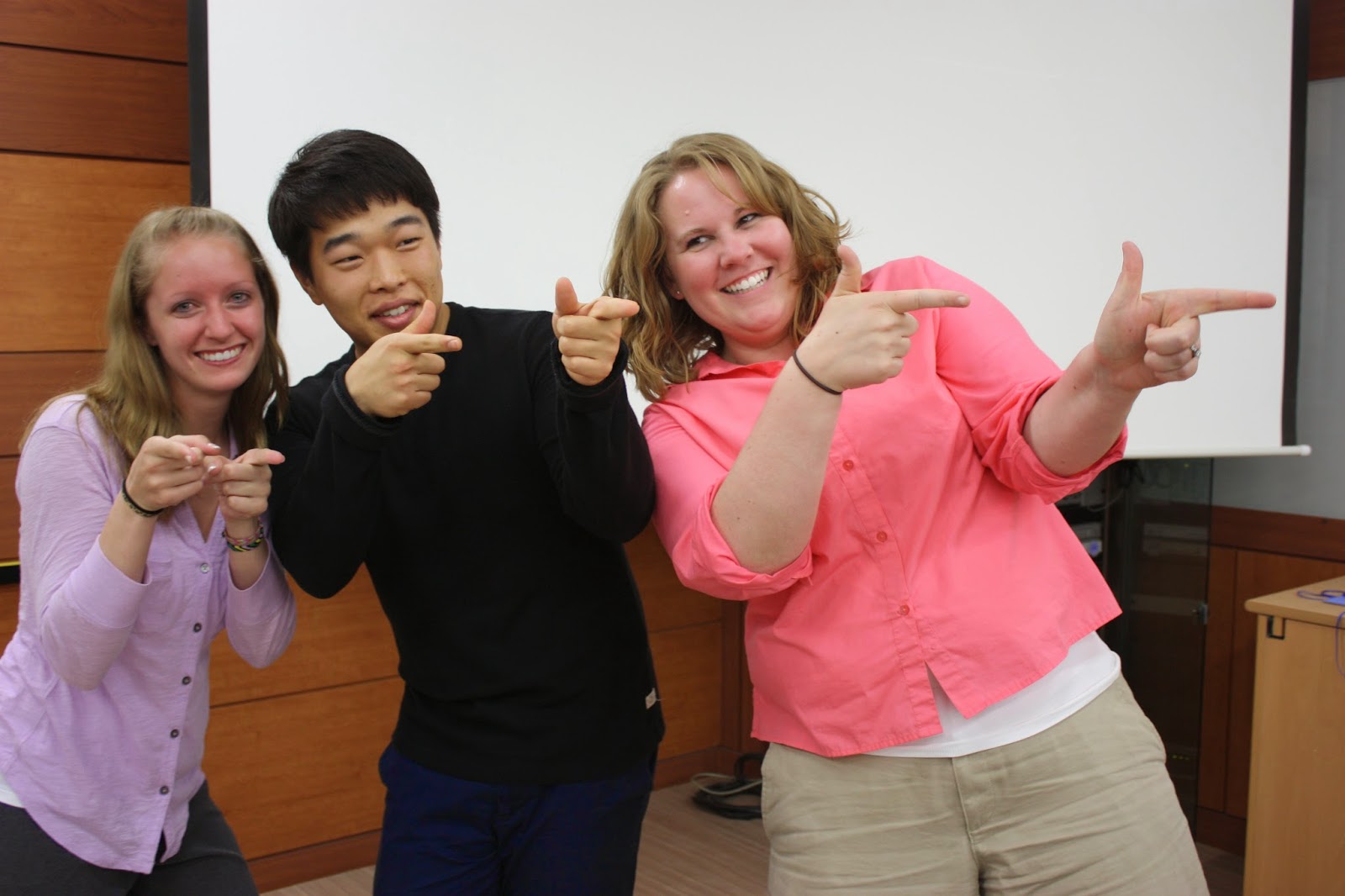
Although we have recently returned to the U.S., we will continue to post thoughts and stories from #AgEd2Korea participants to reflect on the breadth, depth and diversity of our experiences in Korea.  This blog showcases some of the answers to the question, "What was your most meaningful interaction with a Korean person?"

Deanna and her SNU Teaching Partner
"My most meaningful interaction was with my SNU teaching partner. Not only did he help us with translations and logistics, but he helped us to structure our lesson and make it more impactful for the students in the classroom. He could have sat back and watched as we prepared a lesson but he was engaged and inqusitive the entire time. It makes me wonder how I would have responded in his situation." – Deanna

"My most impactful interaction was when we got to meet the Vice Minister of Education, Dr. Na. I am always excited to meet another OSU Alumni, and one who has made such an impact on the education system, just makes it that much more exciting. He had some very insightful words about finding your passion and dedicating yourself to it. If you are not building your passions, you will not have a very rewarding life." - Kelli

Lesson Planning: Kelli, Hee Song and Janae

"I loved working with my SNU teaching partner, Hee Song. She was absolutely awesome! She really had a presence in the classroom and I really enjoyed being able to team-teach with her. What really surprised me though was the note she left me on our last day together. She wrote that my passion for teaching helped to ensure that she was in the right profession as well. It was an incredible complement and she has impacted me in just the same way."
– Janae


"When I went to Insadong for the second time, as I was shopping I had a group of 13 year-olds and their teacher run up to me and speed quiz me on camera as an English project in order to help them learn to better speak English. They were a great group and they were so excited to talk to me and enjoyed talking to me in English & Korean and it was great to see students that excited to learn new languages." - Amanda

"At Buseong Elementary in Gwangju, I asked a 6th grade student how she was doing and she responded in English by saying, “I am happy!” This was evidence of the successful implementation of the school’s mission statement, which included 'Happy Students'.” - David

Jeremy's class at Yeoju High School
"My most meaningful interaction with a Korean has been with the students at Yeoju High School. They were so excited to have us in their classroom and learn about agricultural education in America. They were the friendliest, most respectful students I had ever met and they made me want to come to Korea and teach here for a while!" - Jeremy

"My most meaningful interaction with a Korean was when Jason and I were coming home from a late night out on the town and we met Jim, a Korean student from SNU. Jim was very kind, patient and engaging. We met Jim on the subway, we all three walked home even stopping long enough to grab a bite to eat and drink, just like we had known him for years. He even answered his phone to his girlfriend saying he had met some new friends and would be home late." - Chris

Jessica, Cassidy and Abby having lunch with a Suwon Teacher

"My most meaningful personal interaction with a Korean was probably the day that we went to lunch with the Suwon teachers for bugolgi. It was meaningful because although there was a language barrier, we had a normal conversation, just like I would have with my friends. We talked about our school day, what we love about our jobs, and about our family. It was neat to share those things, and I didn’t feel pressure to make sure I was speaking perfectly. They were just happy to interact with us, like we were with them. I wish I would have exchanged contact information with them, a lesson learned, but I really enjoyed lunch that day, and wish we could have had more one on one time with just the teachers. " - Abby

Teaching Team: Stacia, NeungSu and Jessica
"My most meaningful interaction with a Korean is my work with my SNU teaching partner NeungSu. Through teaching together I really had to rely on him to translate to our class. We also had to work on our own communication together for him to be able to help translate. It has definitely helped me realize how to speak more clearly and how to work with a partner in the classroom. Out of the classroom he has also given me a lot of insight into Korean culture. I have had the opportunity to ask him all about his traditions which was
a lot of fun to learn about." - Stacia


Thursday, July 10, 2014

What was the food like in Korea?

As our departure from Korea quickly approaches, we will be posting thoughts and stories from #AgEd2Korea participants to reflect on the breadth, depth and diversity of our experiences here in Korea.  This blog showcases some of the answers to the question, "What was the food like in Korea?"

"Well, I love surprises, so I guess you can say I love Korean food. It wasn’t always clear what we were eating at meal time but I enjoyed it (for the most part…)! It also encouraged me to try new foods, whether it was intentional or not. "
– Janae 


"I liked that there were many side dishes that were shared as a group. I think it plays back into the cultural mindset of group collaberation. We all shared these dishes and it was just another way for us to emerge ourselves into their culture."
– Deanna

"It’s different. Good luck finding half of this stuff in restaurants back home. Now, I’ll be the first to tell you that I’m a meats and potatoes kind of guy, but, it was great to be in a place where the food was unique, just like the experiences. I remember how excited I got when I saw a street vendor selling silk worm larvae, or when I tried cold noodles for the first time."  – Howard

"I liked the bibimbop the best because there were many different combinations that you could choose from and it was a complete meal that filled you up. "
– Jason

"Variety and spicy is the Korean food cuisine. My favorite dish was the bulgoli because it was not spicy, but had a great flavor. I did enjoy eating more vegetables and fruit and less dairy products and carbs. I felt like I had more energy." - Jess

"I think what I liked best about Korean food was how we weren’t quite sure what we were going to be served at each meal…it was sort of a guessing game as to what dishes you would see on the table."
 - Sarah


"The number of dishes and side dishes that are served with any meal is perhaps the most enjoyable part of Korean food. Through the variety of entrees, soups, salads, and sides served, sometimes up to 30, I was able to try different combinations of flavors that enhanced the sensory experience through taste, texture, sight, and smell!" - David


What surprised you the most about Korea?

As our departure from Korea quickly approaches, we will be posting thoughts and stories from #AgEd2Korea participants to reflect on the breadth, depth and diversity of our experiences here in Korea.  This blog showcases some of the answers to the question, "What surprised you the most about Korea?"

One of the many gourmet meals provided by our gracious hosts
"I was most surprised by the hospitality that I encountered while in country. I can honestly say that I did not have one bad experience while interacting with people. Whether it was while I was shopping, touring, or in the classroom. People were truly excited to meet with us and help us as needed."
 - Deanna

"As we toured the countryside and looked at farms at the different high schools, I was surprised by the amount of technology that these farms used.  I came in expecting a few pastures with some old cows and goats.  But I was blown away by the amount of technology; between the universal use of greenhouses, to seeing a compost aerator, and a robotic milker.   It never stopped amazing me how smoothly technology was integrated into agriculture."
Greenhouse at Yeoju Self-Management High School
 – Howard

"What surprised me the most was how quickly the time seemed to pass by. Today is our very last day in Korea and they say we have been here for a month, but I swear we just arrived yesterday. Each day was filled to the brim with either educational or cultural activities. Even our 'days off' were jammed packed because there was so much to see and do! What I have learned from this though is that every minute you are abroad counts for something. There is always something to be taken from each moment you have."
 – Janae

"I think what surprised me the most was how innovative Korean agriculture is. I was not expecting to see the intensive use of the acreage that we saw while traveling through the Korean countryside. They have extremely intensive production and seem to have a keen awareness of the need for sustainable practices in their country. I was also very impressed at the level of technology and depth of industry education available to high school students!"
– Sarah

Wednesday, July 9, 2014

Happy Education for All: Creative Talent Shapes the Future!

The title of my post is the vision statement for the Ministry of Education for the Republic of Korea.  Today we had the opportunity to meet the vice minister of education Dr. Na.

Dr. Na is a former agriculture teacher, who earned his PhD from The Ohio State University.  It is a small world, where anything is possible.  The fact that he is a former agriculture teacher resonates in my head this afternoon.  Dr. Na is leading the way to have a paradigm shift in Korea, that it is alright for educated people not to have an inflated resume of degrees to become professional citizens of the community.

The idea begins with happy schools, what a novel idea.  Happy schools focus on expanding the student's background of education.  It would include more exposure to the humanities, sports and character building.  Integrating liberal arts with the sciences.  This approach would surely unleash the potential in any student.


Next the plan calls for quality colleges to foster creative talent.  This is accomplished through ideas that we have seen first hand on this trip, opportunities for students to study abroad and truly become a global student.  The use of capstone projects through team activities conducted at the school, and even to compete with the project where there was evidence of industry partnerships.  This will lead to more localized employment for those students and thus a better economy.  Similar to programs FFA had where students worked and studied abroad, perhaps it is time to revisit old ideas that worked.


Finally the piece that interested our group the most was the initiatives in a meritocratic society.  The number of degrees one earns does not mean that the individual is any better or worse than the next individual.  That to create a more even playing field is a positive move in a country that values it's educational programs.  Agriculture education and vocational education in general is taught in the general curriculum, as well as in specialized schools, that promote scholarships to help to encourage students to consider those schools.  

It doesn't matter what country you live in, you want what is best for your children.  I believe I live in such a country and that the United States of America is a place where as the Minister of Education says your dreams of education do come true.  If you can dream it you can achieve it, see you at the top. Thanks Zig, that's why it has been so important on this trip to stay positive.


Wearing Many Hats

Its been a long four weeks, four weeks of being pulled in every direction, four weeks of being flexible, four weeks of cultural immersion, and four weeks with the same group of 20 teachers, professors, and students. We were told about the challenges and differences that we would face while on this adventure, but I think we all overlooked the challenges of defining our roles in this experience.

As an undergraduate student we were expect to wear many hats while here. One hat was to be a student and make mistakes and learn from them and look for guidance from our professors and the experienced teachers.

Another hat was to be a facilitator, we had the opportunity to create a lesson plan with the guidance of an experienced teacher, and complete 3 micro-teachings with this lesson. We were enabled to be the teacher for those experiences, we got to make decisions, and were empowered to create something we were proud to teach and present.

We also wore the hat of a learner.  Every day we were trying to take in as much information as possible, each in our own unique way. For some of us that was asking a question at every presentation, for some it was sitting back and taking it all in, and for others it was bouncing ideas and conversations off of the group later.

We wore the hat of a professional, interacting with everyone from classroom teachers to the Vice Minister of Education. We knew what to do, what to wear and how to act. We have been prepared for these encounters both in high school, youth organizations, and college.

And finally we wore the hat of a pre- service teacher, we are all looking for inspirational ideas to guide us in our future student teaching endeavors.  Though we may not have our own programs yet, we all hope to one day.  We want this experience to shine through in our programs and we want to create more globally competent learners. For many of us this was just another block added to the foundations of why we want to be agricultural educators.

At this point what hat do we wear?  Am I an undergraduate, a student, a professional, or a pre- service teacher?


Here is what I know:

We are coming to the end of a successful four weeks and the stress and pressure has gotten to us all. We have all had an off day where we make the wrong comment or respond more harshly then we should. We are only human, it happens, it has happened and we have moved on. Looking back at it all, those comments and mistakes wont be important, they are just another hat thrown into the mix that doesn't quite fit. We will keep pushing forward, and we will rally our spirits and moral and end this trip with a plan for success.

We have worn many hats, and they get confused at times.

But, looking back we will remember...


That this experience has impacted us all for the better. We will all leave this experience with a connection that only we can understand. We all stretched together, we all learned together, and we all juggled the hats and walked the line together, and all that's left now is to cast our line to the rest of the world!

Tuesday, July 8, 2014

Where do we go from here....

As our time in The Republic of Korea comes to a close in the next few days, I find myself getting into that reflective mode that we find ourselves in after long trips like these. I continue to find that every time I think I can't be more surprised - and at the same time educated - I find another reason to be kept in awe of this place.

Sometimes it's in the culture.

Whether it's the different kinds of foods ate over here, or whether it's walking into the dairy barn at Yeoju High School and finding a robotic milker, I continue to find inspiration and be awe-struck by the people and the landscape that I see around me.

Robotic Milker found at Yeoju High School.


Even the students can shock you.

It might sound corny, and like something you'd hear in a commercial, but I continue to be amazed by these students, who while coming from no agricultural background, still become so involved with their classes and clubs. Students choose the path they want to take in school, which leads to students taking control of their learning, which in the end is what we want.   These students are more passionate about agriculture education than many students I find back home, and like I said before, many don't even come from an agricultural background.

Students learning about tractor maintenance in Ag Machinery.
Because of this student-driven education, students are more excited to go to class, and will even continue their learning outside of the classroom. Many of these students are involved in clubs outside of school, whether its in the FFK (Future Farmers of Korea) or they are in the excavating club (yes, you read that right, their is an excavating club at Yeoju High School), these students are getting the opportunities to not only expand their knowledge on a topic, but to also have fun while doing so.
  After school clubs are completely optional, but yet we found that many of the students are involved in some way or another.

Many students also have projects that they work with inside and outside of the classroom. Students are involved in a multitude of projects including: small animal/companion animal care, dairy production, crop/vegetable production, agri-business, nursery landscaping, or mechanics. These projects are giving students the opportunity to become self-sufficient, as students are given the profits from all projects that they work on. Using these hands-on educational opportunities that the schools provide, students are growing their own love and passion for agricultural education.

Maybe its even me just shocking myself.

When I first got to Korea, I was extremely nervous about teaching in the high schools. Between the language barrier, the shock of being in a completely different place, and constantly wondering if my micro-lesson would be relevant, I often wondered if I would make even the slightest impact. I was blessed to be paired with my teaching partner Chris Wilder, who teaches at Williston High School in Williston, FL, and my SNU (Seoul National University) student partner Yuna.

Chris is an amazing teacher who worked with me and Yuna to develop a lesson plan that we believed the students would be interested in and would gain real-life skills from. Yuna served as my teaching partner and as a translator. Her passion for plant science and here skills with translating made the transition to teaching in a Korean High School that much easier.

Our lesson plan involved teaching asexual propagation to students, specifically teaching students to take a cutting from a parent plant, and plant it in a new container to grow a genetically identical, but completely separate, plant.

Like I said, going into the classroom, I was completely nervous about teaching, but, I was amazed at the end of class, when we were reviewing, to hear the questions that students had. One student asked what plants at home she could reproduce through cuttings, another asked if all plants could be propagated through cuttings, one even asked us about the history of cuttings and who was the first to use it in cultivation, to which none of us could answer off hand (we told her while we were not sure, we made an educated guess). It gave me great pride to hear and see these students taking interest in the subject and want to know more about it.

But what really inspired me was that by the third time Yuna helped teach the class, she went from not knowing much about the topic of asexual propagation, to answering students questions on her own, and teaching segments without our help. I hope she can use this knowledge to continue her studies and develop the passion she has.

To be completely honest, I'm not sure where I'll go from here. All I know is that using the knowledge and skills I learned here in Korea, I will do everything possible to inspire and educate students back home about the wonders of global agricultural education.


Chris, Yuna and I after teaching


Yeoju Agricultural High School- a place I would want to teach

Wow what a month it has been! I can't believe we only have two more days here in Korea. I have learned so much and have gained valuable memories that one day I can bring into my future classroom and that I can take home and share with those I interact with.

Just a friendly hello
Monday and Tuesday I had the chance to tour, teach and shadow students at Yeoju Agricultural High School. 

The composter


Never in a million years would I imagine such technological advancements in a high school setting. From the composting machine to the robotic milkers, Yeoju is high school ahead of the times. The school also has facilities to produce yogurt and cheese as well as sausage. After touring the school the ideas of sustainability as well as organic agriculture were evident everywhere we went. The vice principle was extremely proud to tell us all about their organic practices and how no chemicals are used on any of their crops.
Getting to teach in the classroom was also a great experience. Since our lesson was on sustainability it was very easy to tie in the school's practices into our lessons to allow the students to grasp our concepts better. I really enjoyed our group of students and it appeared that our SNU student teaching partner really enjoyed being in front of the classroom as well. Having the chance to teach with someone who speaks a different language is certainly a unique experience.

Touring the facilities especially their dairy barns was hands down my favorite part of the day. Coming from a dairy farm at home I could not wait to see some black and white spotted animals! I was also really interested in what a Korean parlor would look like. And to my surprise they did not have a parlor but two robotic milkers instead!

The robotic milker

My mind was blown and I could not wait to learn more about their animal science program. Having visited a few larger dairy farms in Pennsylvania as well as one in Indiana my appreciation and interest in robotic milkers began. Our small farm in western Pennsylvania has a traditional parlor and having the chance to compare ours to that here at Yeoju was amazing. Although there were many differences I was able to find similarities as well. One of which was the equipment brand used at Yeoju!
I could see the passion for animals all over the Yeoju campus and how much the students enjoyed working with animals everyday.

On Tuesday I had the opportunity to observe in one of the animal science classrooms. We spent the entire class period outside where our teacher showed us their facilities where small animals were raised by the students. Some students had "pets" of their own such as dogs where others worked in groups to take care of horses, goats, chickens, and a sheep. The students were very excited to show us their dogs and tell us a little about them such as their names. It was also great to see the level of respect the teacher had for his students. Once class started the students went right to work taking care of their animals. A group of 3 students were helping each other out to bathe their dogs. It was really interesting seeing how well they worked together and how much pride each student had in their projects.

A student's small animal project
I took away so much from my time at Yeoju Agricultural High School and I can not wait to share what I have learned with my family, friends, peers, and future students. I had a blast and the experiences I have gained are going to last me a life time and will impact many others.

I am sad to be leaving the Republic of Korea however, I know my time here was not wasted and I have gained so much! Hopefully one day I may return, or someone I interact with will take this leap into a new world!


The journey has just begun...

Four days left...

This trip has been an amazing opportunity, and unfortunately while our time here in Korea is quickly coming to an end, our journey has just begun. On this trip we've made lots of memories - traveling to different schools, visiting museums, and eating lots of food - but the biggest impact this trip has made on me already has been meeting and getting to know people, especially with the other 19 people in our travel group. 

While all of us got to know each other a little bit over the course of our spring course, there is only so much you can learn about a person during a two-hour, once a week, online course and even within the first few hours of this trip, over three weeks ago, we were learning new things about each other. I have always been told that you don't truly know someone until you spend all your time around them, and spending a month together in a foreign country can certainly speed along that process.
One of my last sunsets in Seoul enjoyed with friends

"The great difference between voyages rests not with the ships, but with the people you meet on them" - Amelia E. Barr

The above quote reminds me of just how important who you travel with can be just as important as where you are traveling to. For me, this experience would not have been as influential if not for my travel companions, our partners at the universities, and even the random people who came up to me on the street, whether they wanted to talk to me in English or just wanted to help if I was lost. 

If you had asked me a week ago where I wanted to look for teaching jobs post-graduation I would have said somewhere in the Northeast, not necessarily only in Pennsylvania but in that region. But now that I've had several serious conversations with our mentor teachers on this trip, learning all about their programs and the surrounding programs, this is the first time I've considered moving states away to teach. While I think I've always been open to moving for a teaching job, the distance I would go is much greater now than it was before. While I don't think I'm ready yet to consider moving across the ocean to teach, I am looking forward to visiting Florida and other states, learning about their agricultural education programs, expanding my net of possibilities. 

This experience has been eye-opening for me, not only in learning about the Korean culture, but also about our own, and how we look at and treat the people and world around us. Every encounter I've made while here has been a positive experience, and I think that all of us would agree that no matter whether it was the students we were micro-teaching, the university students we worked with, or the random strangers we met while wandering Insadong, we have learned more from each person we've met than I think we even know right now. 

The great group of people I've shared this experience with.
Creating friendships across the world has been amazing, and thanks to wonderful technology like Facebook and Twitter, we can stay updated on each other's lives very easily, but I am also looking forward to when we meet in person again. The other Penn State students and I will be around each other a lot even after we get off the plane, but I am looking forward to meeting up with all the teachers again come National FFA Convention in October, and maybe even a trip to Florida sometime soon. And maybe one day we'll even meet up in another foreign country, whether planned or chance. 

Going home at the end of this week will be great, but I know that I am already missing the wonderful friends I have made on this trip and the positive difference this experience has made on me is largely due to the people I've traveled with. While this Korean experience is coming to an end, our journey together spreading the message and importance of agricultural education has just begun.

Monday, July 7, 2014

Third Time's The Charm

Third time's the charm!  Many have heard this saying from time to time and today was no different.

Today was the last day that we got to teach our micro-lesson.  It was a bittersweet moment, mainly because it means that we will be heading home soon to our family and friends, but also sad that we are leaving this wonderful country and the friends that we have made.

The last school that we visited was the Yeoju Agricultural High School which was established in 1945 with currently 450 students and 84 teachers on staff.   The school is compromised of 99 hectares (246 acres) with the school having its own processing factories for sausage, beef, yogurt and cheese.  On the school you will find 180 cattle with a robotic milking parlor, 32,000 organic chickens, 2,800 hogs and several horses and dogs.  Yeoju High School has a store on campus where they sell their products and also provide some of the food in the school's cafeteria and surrounding schools.

Yeoju High School feed mill for animals.  
After touring and hearing about the great opportunities that students have at Yeoju, the time came for us to teach our final lesson.  The materials were all gathered, the Powerpoint was tweaked and the nervous jitters that we experienced during the first teaching day were gone.  We were a well oiled machine.  There was no more anxious nerves of what could go wrong.  No more awkward  pauses of wondering who was going to say what, our roles where defined and we owned it.

Yeoju High School students figuring out the problem
of who started the disease in the biosecurity  lesson
As a teacher it was great to see my Penn State pre-service teacher, Stacia, and SNU student Neungsoo grow as teachers each time the lesson was taught. I could not be more proud of the pre-service teachers that I worked with.  For many, they never even taught a lesson in an English-speaking high school and here they were teaching students whose second language was English.     It speaks volumes of what type of teachers these young aspiring agriculture teachers will be!

During our time after the lesson we reflected on the lesson of the day.  Things that the group learned as a whole were:   technology will always fail and it is good to have a plan B or even a plan C; using extrinsic motivation is good sometimes, but is not practical everyday; a rowdy class does not mean that they are not learning; even with a language barrier deeper level learning can occur; and a little bit of rivalry is sometimes a good thing.

As teachers, we have our good and bad days, week or even a year, but we need to take what we learned and grow as an educator.  "Good teachers are made, not born." - a quote by Dr. Foster.  Instead a good teacher reflects, learn from their mistakes and improve for the next time.
Stacia, Neungsoo and students from Yeoju.  
Though it is sad that our time is done as "teachers" in Korea, it was a great experience.   Dr. Barrick said it best when he said that "Learning was occurring in the classroom."   I think learning was occurring for the students as much as it was for us as teachers.    

Sunday, July 6, 2014

Should I stay or should I go??


Wow! Today is our 22nd day in Korea with only five days left! The time has flown by so fast! We have had so many great adventures here. I was just thinking today about all of the different things that we have done and they all feel like they just happened yesterday.

This month has literally been the best month of my life! I have experienced so many things that I would have never thought in a million years that I'd get to do. From the Seoul Tower and museums to the nights dancing in Itaewon, this trip has been absolutely amazing.  I have learned so much about the culture here and those impacts on their agricultural industry.

View of Seoul from Seoul Tower

After spending a month in Korea and visiting several schools, I have been contemplating the possibility of moving to Korea in the future to teach agriculture; or at least work within the agricultural industry. It is obviously a very big decision to make, so I do not have a clear answer as of now, but I really think it is a possibility. I have witnessed so many techniques in agriculture here that I would really love to learn and try! I love the fact that the agricultural teachers teach a specific specialization within their programs. I know that I would be great at teaching landscape design here and I would really like the challenge.

Korea has proven itself to be very hospitable and all of the Koreans I have met love Americans. The relationship that Koreans and Americans have, or at least from what I have experienced, have been truly like family. I cannot tell you how many times I have been stopped in the streets and offered help or have been asked to take a picture with someone.

Agriculture in South Korea - Rice Patties
The only thing that was a problem from me at the beginning of the trip was the food. So much of it is seafood and the stuff that is not seafood tastes like it (I hate seafood!). However, after spending only a few free days out on the town I have come to realize that there are so many places and choices to eat that do not taste like seafood!  Considering that food was the only thing holding me back, (and that's a big thing for me) this makes it even easier for me to choose to answer my question of staying or going!

Downtown Seoul

Overall, this trip has proven to be very inspirational and educational to me. I've learned so much about culture and how different, yet similar, another culture is to the US and I have really come to respect those differences. The agriculture here also has so many similarities and differences. Though everything here has been so great, the big question still remains: Should I stay or should I go? Is Korea worth the time? Worth the experience? Worth the education? I can honestly answer yes to all of these things, so the real question I should ask myself is "when?" I might as well while I am young! Experiences like this don't just happen and I really think I should take advantage of it...

These are just my thoughts for the past few days! Your comments and feedback would be appreciated.